'%3e %3cpath d='M15.9571 0.231934L0.147583 9.39139V32.66L15.9571 41.8195L31.7665 32.66V9.39139L15.9571 0.231934ZM15.9571 33.0172L7.68318 28.2206V13.7798L15.9571 9.00869V23.424L24.2309 28.2206L15.9571 33.0172Z' fill='%23170E30'/%3e %3cpath d='M107.275 23.3727C107.275 22.9645 107.275 22.6073 107.275 22.2756C107.275 21.6377 107.021 20.311 106.766 19.7242C104.628 14.6214 96.3791 15.5144 95.5645 21.3316C94.648 28.0417 102.438 30.9248 106.613 26.2302L104.678 24.929C102.464 26.8936 98.9759 26.5619 98.2885 23.3982H106.384H107.275V23.3727ZM98.2885 21.3826C99.0268 17.9382 103.966 17.7596 104.449 21.3826H98.2885ZM58.472 16.5095C53.9914 15.7441 51.1147 19.1629 51.522 23.4492C51.9802 28.0672 57.8865 30.2614 61.0688 26.766V28.1438H63.9964V16.3309C63.9964 16.3309 61.1706 17.9638 61.0433 18.0403C61.0433 18.0403 59.7959 16.7391 58.472 16.5095ZM57.3264 25.822C53.5077 25.3883 53.5332 19.6987 57.0464 19.1119C62.469 18.1934 62.5963 26.4088 57.3264 25.822ZM126.929 25.4648C126.471 29.5981 118.197 29.3429 116.924 25.6944L119.011 24.4698C119.597 26.1537 122.881 27.1487 123.95 25.6944C125.274 23.9085 121.048 23.4747 120.055 23.092C118.91 22.6328 117.586 21.8419 117.408 20.5151C116.72 15.5655 124.765 14.9786 126.623 18.6781L124.689 19.8263C124.103 18.2954 120.157 17.479 120.284 19.6222C120.361 20.8468 123.517 21.204 124.561 21.6633C126.318 22.4287 127.132 23.4747 126.929 25.4648ZM90.5492 18.2954C87.2142 14.3918 81.3334 16.8667 80.8497 21.7908C80.3151 27.4294 86.5523 30.8993 90.5238 26.6129V28.1438H93.2987V12.1211H90.5238V18.2699L90.5492 18.2954ZM87.7998 25.7965C83.1409 26.5874 82.2499 19.7497 86.4759 19.0864C91.2366 18.3465 92.0003 25.0566 87.7998 25.7965ZM75.8599 18.2954L74.918 17.3004C70.0555 14.3408 65.0657 19.0098 66.4404 24.2402C67.4333 28.0162 72.2958 29.9808 75.3253 27.2253C75.5544 27.0212 75.6053 26.6895 75.8599 26.6129V28.1438H78.6348V12.1211H75.8599V18.2699V18.2954ZM73.1104 25.7965C68.3752 26.4854 67.7897 19.7497 71.8121 19.1119C76.7 18.321 77.311 25.2097 73.1104 25.7965ZM112.392 16.6115H109.465V28.1693H112.392V21.102L115.6 19.2394V16.3054C114.709 16.8156 112.876 17.8872 112.392 18.1679V16.6115ZM42.4335 25.3883H49.969V28.1693H39.353V13.7795H42.4335V25.3883Z' fill='%23170E30'/%3e %3c/g%3e %3cdefs%3e %3cclipPath id='clip0_1_15718'%3e %3crect width='127' height='42' fill='white'/%3e %3c/clipPath%3e %3c/defs%3e %3c/svg%3e)

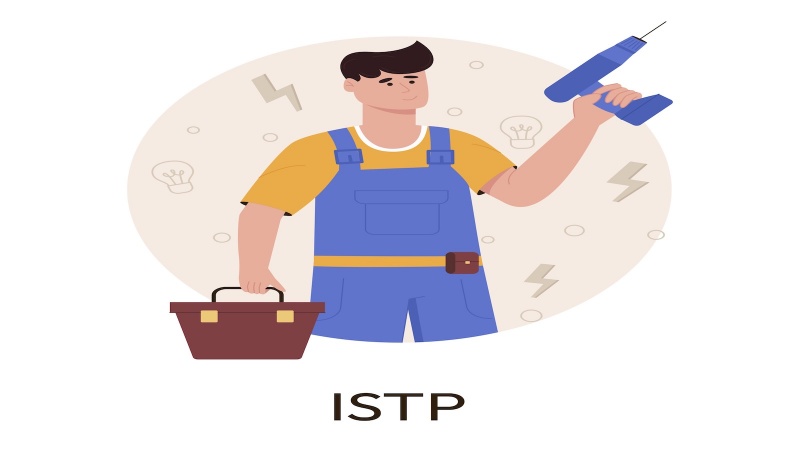
The Myers-Briggs personality test defines the ISTP personality type as the crafter. There are many other words used to describe the ISTP-T person, such as logical, pragmatic, action-oriented, and more. But before going into the description of an ISTP personality, it’s important to break down what each letter (I-S-T-P) stands for.
Learning about the ISTP Myers-Briggs personality type will provide you with insight into its strengths and weaknesses and which career this personality would thrive in.
Basics of the Myers-Briggs personality test
The Myers-Briggs test asks participants a series of questions, which they rate on a scale. The test is then scored on four different scales or dichotomies. These scales are as follows:
- Extraversion (E) versus Introversion (I)
- Sensing (S) versus Intuition (N)
- Thinking (T) versus Feeling (F)
- Judgment (J) versus Perceiving (P)
Consequently, the results identify up to sixteen different personality combinations that are made up of four different scales. For example, you could score an I on the first scale and an S on the second scale, a T on the third scale, and a P on the fourth scale. This would result in the ISTP personality addressed in this article. Each personality combination is also referred to by a name that helps define the personality further.
The total combinations and accompanying names possible are as follows:
- ISTJ: The inspector
- ISTP: The crafter
- ISFJ: The protector
- ISFP: The artist
- INFJ: The advocate
- INFP: The mediator
- INTJ: The architect
- INTP: The thinker
- ESTP: The persuader
- ESTJ: The director
- ESFP: The performer
- ESFJ: The caregiver
- ENFP: The champion
- ENFJ: The giver
- ENTP: The debater
- ENTJ: The commander
Overview of the ISTP personality
As you can see, the ISTP is referred to as the crafter. This personality type is made up of the four following dominant scales:
Introversion: This is a more introverted, reserved, and quiet person compared to extroverted people.
Sensing: A person who pays close attention to physical reality uses their senses to make decisions. This personality scale involves being focused on what is actual, present, and real. They tend to be fact- and detail-oriented. They are also quite practical in the use of objects.
Thinking: A person who leans more toward thinking versus feeling tends to use facts and logic as they solve problems and make decisions.
Perceiving: The perceiving person involves more improvision as the person completes tasks. They can be creative and work well with others due to their flexibility.
Personality traits common among ISTPs
Since ISTPs are generally more logical, practical people, they can work well on problems or troubleshooting. They do well with working independently since they are introverted. In fact, working alone may be the best scenario for them in the workplace.
ISTP people are also thoughtful when working on a job. They pay attention to the details, which means they are more apt to do a thorough job at what they do. They would also see mistakes or problems in systems more quickly, which is an asset for certain types of jobs.
The following personality traits are closely associated with ISTP types:
- Capable
- Curious
- Detail-oriented
- Effective
- Flexible
- Logical
- Observant
- Meticulous
- Practical
- Problem-solver
- Quiet
- Rational
- Reflective
Career paths for the ISTP personality type
Knowing your ISTP personality traits can help you seek out the best career path. People are happier when they work in a field that is a good fit for them. The following is a list of some career options that would work well for the ISTP personality type.
Computer programmer: Attention to detail would be helpful in this position, as would being attentive to problems.
Engineer: Engineering requires an analytical mind. ISTPs can also grasp the intricate workings of things, which is necessary for an engineer. Also, since engineering has tangible results, it is an attractive field for ISTP people.
Inspector: Inspectors must have an eye for errors, problems, and details. This is exactly what an ISTP is adept at doing. They are also usually able to memorize information easily.
Machinist: A machinist must have a lot of focus on the equipment, which could be complex and expensive. They need to be very careful in handling the machinery. It also may be an attractive job since the person will work alone.
Technical worker: Similar to an engineering job, a technician will require a strong focus and a detail-oriented style. Technical work could include working on a range of items, such as electrical items, HVAC equipment, airplanes, and more.
Scientist: Scientists are problem solvers, which is something ISTPs like to do. Forensic scientists work in a quiet lab environment. They must focus on the project details and carefully collect and analyze their samples. It requires strong attention to detail and an excellent memory.
Pilot: A pilot has a huge responsibility of transporting people. They must work with many controls and gauges that are delicately tuned to move the plane at certain angles and degrees. If they don’t do things precisely, a person could get off course or worse. A pilot must be able to focus on the task at hand and also be extremely precise.
You can use the knowledge about the ISTP personality type in your pursuit of a career. Highlight some of these skills on your resume, so recruiters and interviewers know what abilities you bring to the table.
Check out:
ENTP personality type: The rare traits of a “Visionary”
ENTJ personality type: The traits of a born leader
ISFJ personality type: “The Defender”
INTP personality type: Traits of the “Thinker”