'%3e %3cpath d='M15.9571 0.231934L0.147583 9.39139V32.66L15.9571 41.8195L31.7665 32.66V9.39139L15.9571 0.231934ZM15.9571 33.0172L7.68318 28.2206V13.7798L15.9571 9.00869V23.424L24.2309 28.2206L15.9571 33.0172Z' fill='%23170E30'/%3e %3cpath d='M107.275 23.3727C107.275 22.9645 107.275 22.6073 107.275 22.2756C107.275 21.6377 107.021 20.311 106.766 19.7242C104.628 14.6214 96.3791 15.5144 95.5645 21.3316C94.648 28.0417 102.438 30.9248 106.613 26.2302L104.678 24.929C102.464 26.8936 98.9759 26.5619 98.2885 23.3982H106.384H107.275V23.3727ZM98.2885 21.3826C99.0268 17.9382 103.966 17.7596 104.449 21.3826H98.2885ZM58.472 16.5095C53.9914 15.7441 51.1147 19.1629 51.522 23.4492C51.9802 28.0672 57.8865 30.2614 61.0688 26.766V28.1438H63.9964V16.3309C63.9964 16.3309 61.1706 17.9638 61.0433 18.0403C61.0433 18.0403 59.7959 16.7391 58.472 16.5095ZM57.3264 25.822C53.5077 25.3883 53.5332 19.6987 57.0464 19.1119C62.469 18.1934 62.5963 26.4088 57.3264 25.822ZM126.929 25.4648C126.471 29.5981 118.197 29.3429 116.924 25.6944L119.011 24.4698C119.597 26.1537 122.881 27.1487 123.95 25.6944C125.274 23.9085 121.048 23.4747 120.055 23.092C118.91 22.6328 117.586 21.8419 117.408 20.5151C116.72 15.5655 124.765 14.9786 126.623 18.6781L124.689 19.8263C124.103 18.2954 120.157 17.479 120.284 19.6222C120.361 20.8468 123.517 21.204 124.561 21.6633C126.318 22.4287 127.132 23.4747 126.929 25.4648ZM90.5492 18.2954C87.2142 14.3918 81.3334 16.8667 80.8497 21.7908C80.3151 27.4294 86.5523 30.8993 90.5238 26.6129V28.1438H93.2987V12.1211H90.5238V18.2699L90.5492 18.2954ZM87.7998 25.7965C83.1409 26.5874 82.2499 19.7497 86.4759 19.0864C91.2366 18.3465 92.0003 25.0566 87.7998 25.7965ZM75.8599 18.2954L74.918 17.3004C70.0555 14.3408 65.0657 19.0098 66.4404 24.2402C67.4333 28.0162 72.2958 29.9808 75.3253 27.2253C75.5544 27.0212 75.6053 26.6895 75.8599 26.6129V28.1438H78.6348V12.1211H75.8599V18.2699V18.2954ZM73.1104 25.7965C68.3752 26.4854 67.7897 19.7497 71.8121 19.1119C76.7 18.321 77.311 25.2097 73.1104 25.7965ZM112.392 16.6115H109.465V28.1693H112.392V21.102L115.6 19.2394V16.3054C114.709 16.8156 112.876 17.8872 112.392 18.1679V16.6115ZM42.4335 25.3883H49.969V28.1693H39.353V13.7795H42.4335V25.3883Z' fill='%23170E30'/%3e %3c/g%3e %3cdefs%3e %3cclipPath id='clip0_1_15718'%3e %3crect width='127' height='42' fill='white'/%3e %3c/clipPath%3e %3c/defs%3e %3c/svg%3e)


Is it just you and the office cleaners again? Amerisleep polled 1,188 workers, 90% of which have stayed late at work by at least 15 minutes, and 75% say they’ve had a job that’s asked too much of them.
Working late is common and often necessary; 66% of employees polled work late “sometimes” or “often.”
Follow Ladders on Flipboard!
Follow Ladders’ magazines on Flipboard covering Happiness, Productivity, Job Satisfaction, Neuroscience, and more!
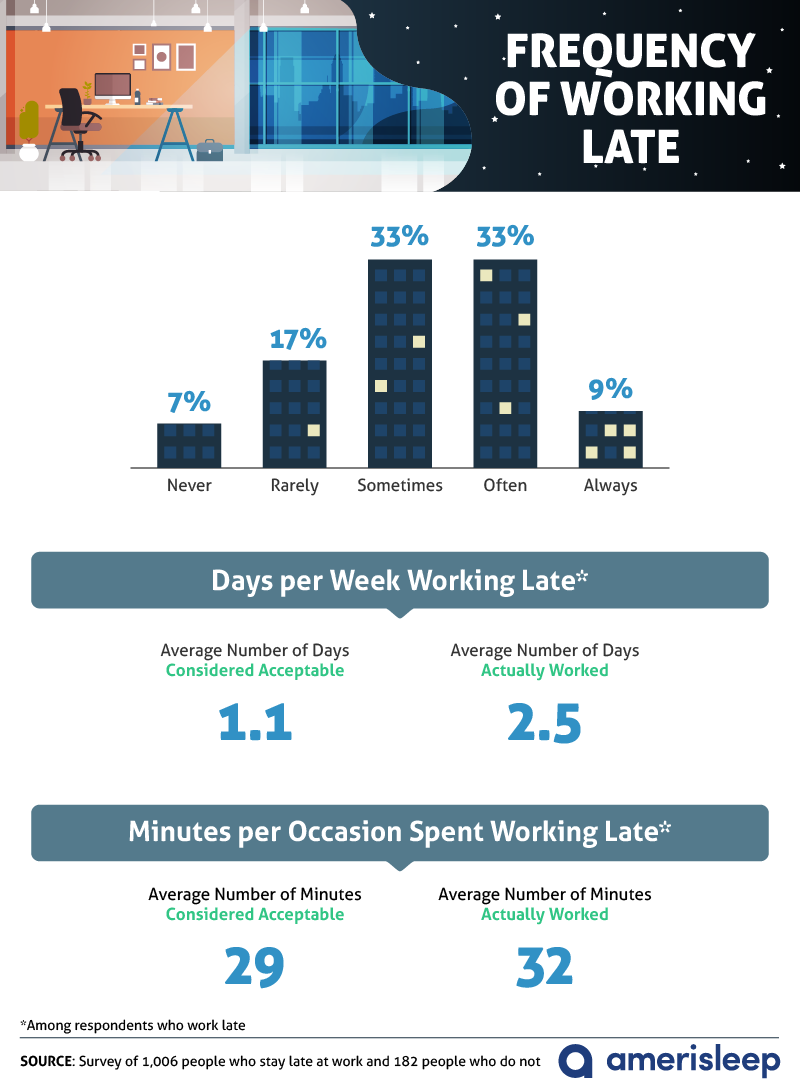
People tolerate it – to an extent. Respondents consider one day a week working late and 29 minutes overtime “acceptable.”
Too much more may bum you out. The results of a study published in PLoS ONE in 2012 suggest that people who regularly work more than 11-hour days had over twice the chances of developing major depression, compared to employees who worked about eight hours a day.
A full 82% of respondents were asked, or pressured, by a manager to work late. Of those who felt “pressure,” to work late, 69% felt that their job was at risk if they didn’t do it.
Work smarter, not longer?
You may not even perform your best working late. According to a study, it’s easier to get stressed in the evening, because your body releases less cortisol – the body’s stress hormone – in the evening, as opposed to the morning.
The culture of working overtime slides into home life. Respondents said working late caused them to break promises to their spouse (56%), friend (55%), or child (48%). Because of working late:
- 66% spent less time spent with family
- 61% spent less time spent with spouse
- 53% spent less leisure time at home
Researchers at Cornell University found that 10% of employees working more than 50 hours a week had serious issues at home. That percentage rose to 30% when they worked more than 60 hours.
Working late had a negative effect on the emotional well-being of 57% of workers, and the physical well-being of 54% of them.
A well-known study following over 10,000 civil servants in London found that overtime work is bad for the heart – people who worked three or more hours longer than a seven-hour day had a 60% higher risk of heart-related problems such as “death due to heart disease, non-fatal heart attacks, and angina.”
Of course, you don’t even want to know what terrible overtime-related malady they have in Japan: karoshi, or death from overwork.
You might also enjoy…
- New neuroscience reveals 4 rituals that will make you happy
- Strangers know your social class in the first seven words you say, study finds
- 10 lessons from Benjamin Franklin’s daily schedule that will double your productivity
- The worst mistakes you can make in an interview, according to 12 CEOs
- 10 habits of mentally strong people