'%3e %3cpath d='M15.9571 0.231934L0.147583 9.39139V32.66L15.9571 41.8195L31.7665 32.66V9.39139L15.9571 0.231934ZM15.9571 33.0172L7.68318 28.2206V13.7798L15.9571 9.00869V23.424L24.2309 28.2206L15.9571 33.0172Z' fill='%23170E30'/%3e %3cpath d='M107.275 23.3727C107.275 22.9645 107.275 22.6073 107.275 22.2756C107.275 21.6377 107.021 20.311 106.766 19.7242C104.628 14.6214 96.3791 15.5144 95.5645 21.3316C94.648 28.0417 102.438 30.9248 106.613 26.2302L104.678 24.929C102.464 26.8936 98.9759 26.5619 98.2885 23.3982H106.384H107.275V23.3727ZM98.2885 21.3826C99.0268 17.9382 103.966 17.7596 104.449 21.3826H98.2885ZM58.472 16.5095C53.9914 15.7441 51.1147 19.1629 51.522 23.4492C51.9802 28.0672 57.8865 30.2614 61.0688 26.766V28.1438H63.9964V16.3309C63.9964 16.3309 61.1706 17.9638 61.0433 18.0403C61.0433 18.0403 59.7959 16.7391 58.472 16.5095ZM57.3264 25.822C53.5077 25.3883 53.5332 19.6987 57.0464 19.1119C62.469 18.1934 62.5963 26.4088 57.3264 25.822ZM126.929 25.4648C126.471 29.5981 118.197 29.3429 116.924 25.6944L119.011 24.4698C119.597 26.1537 122.881 27.1487 123.95 25.6944C125.274 23.9085 121.048 23.4747 120.055 23.092C118.91 22.6328 117.586 21.8419 117.408 20.5151C116.72 15.5655 124.765 14.9786 126.623 18.6781L124.689 19.8263C124.103 18.2954 120.157 17.479 120.284 19.6222C120.361 20.8468 123.517 21.204 124.561 21.6633C126.318 22.4287 127.132 23.4747 126.929 25.4648ZM90.5492 18.2954C87.2142 14.3918 81.3334 16.8667 80.8497 21.7908C80.3151 27.4294 86.5523 30.8993 90.5238 26.6129V28.1438H93.2987V12.1211H90.5238V18.2699L90.5492 18.2954ZM87.7998 25.7965C83.1409 26.5874 82.2499 19.7497 86.4759 19.0864C91.2366 18.3465 92.0003 25.0566 87.7998 25.7965ZM75.8599 18.2954L74.918 17.3004C70.0555 14.3408 65.0657 19.0098 66.4404 24.2402C67.4333 28.0162 72.2958 29.9808 75.3253 27.2253C75.5544 27.0212 75.6053 26.6895 75.8599 26.6129V28.1438H78.6348V12.1211H75.8599V18.2699V18.2954ZM73.1104 25.7965C68.3752 26.4854 67.7897 19.7497 71.8121 19.1119C76.7 18.321 77.311 25.2097 73.1104 25.7965ZM112.392 16.6115H109.465V28.1693H112.392V21.102L115.6 19.2394V16.3054C114.709 16.8156 112.876 17.8872 112.392 18.1679V16.6115ZM42.4335 25.3883H49.969V28.1693H39.353V13.7795H42.4335V25.3883Z' fill='%23170E30'/%3e %3c/g%3e %3cdefs%3e %3cclipPath id='clip0_1_15718'%3e %3crect width='127' height='42' fill='white'/%3e %3c/clipPath%3e %3c/defs%3e %3c/svg%3e)

• Nearly 1 in 3 Americans fell for a phone scam in 2020.
• Younger people are more prone to phone scams.
• The FCC recently made phone companies implement new safety measures.
Robocalls and phone scammers are not only annoying, they’re thieves.
Nearly one in three Americans said they fell for a phone scam in the past year, resulting in billions of dollars lost due to prank calls on landlines and cellphones.
New research by Truecaller found that more than 59 million Americans were affected by phone scammers — resulting in nearly $30 billion lost during the pandemic.
On average, Americans that fell for scams lost $502 last year — up from $351 in 2020. Of those, 60% of people reported robocalls coordinating the attack.
Popular scams include the “we’re calling about your car warranty” and the “urgent” call from the IRS. And they are happening to just about everyone.
Younger people fall for scams most often
Recent data by the Federal Trade Commission (FTC) found that people ages 20-29 fell more often for fraud scams than older generations.
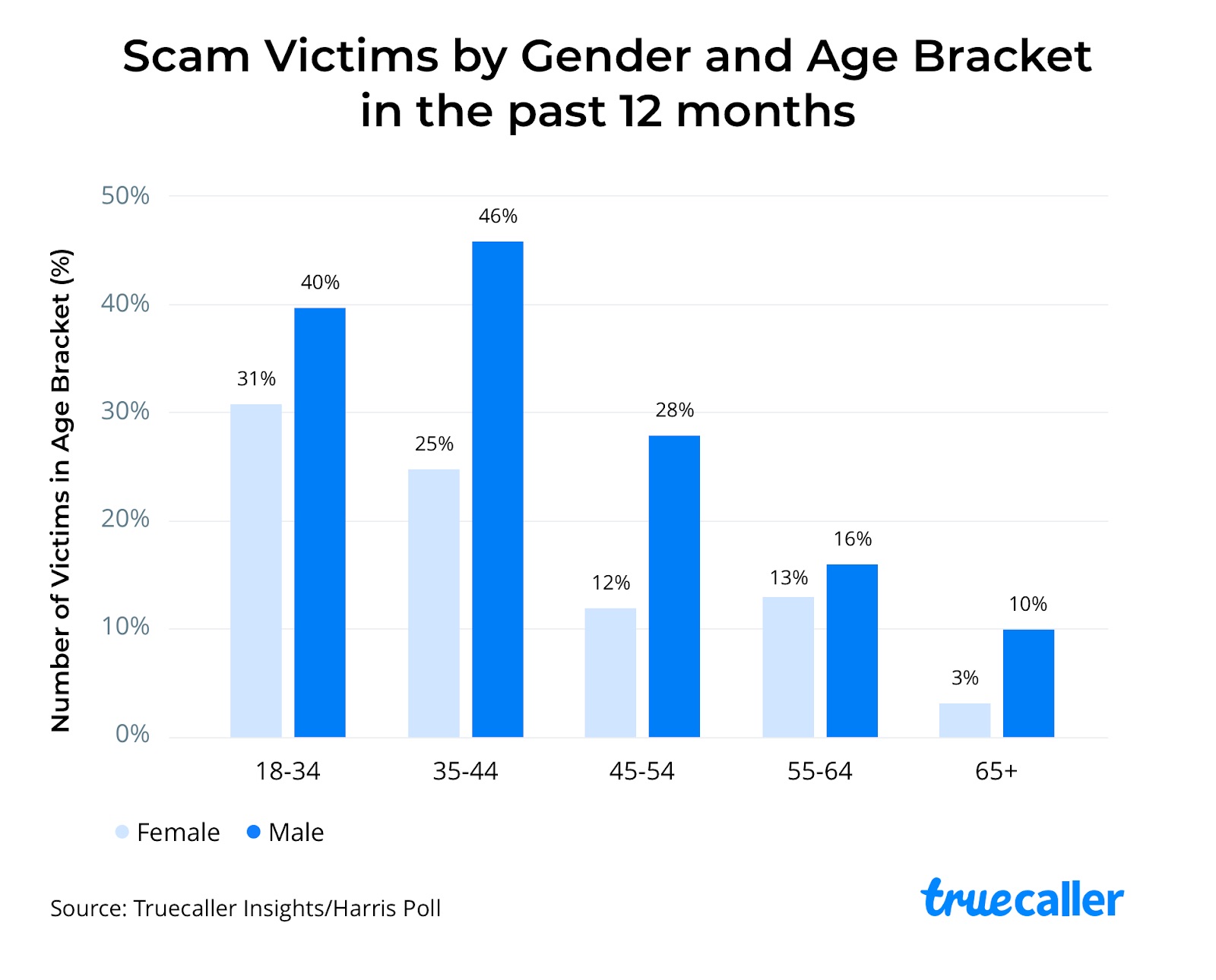
Forty-six percent of men aged 35-44 fell for phony calls, according to the data. Interestingly, men are more likely to fall victim than women across all age brackets.
Thirty-one percent of women aged 18-34 fell for scams in the past 12 months, making them the largest female demographic to be robbed, compared to just 3% of women 65 and over.
Most scam calls happen on your cellphone
Since 2014, scam calls over mobile phones have nearly doubled; 85% of cell phone owners in 2021 experienced the problem. The incidence on landlines meantime has since decreased — 36% of people on landlines experienced it in 2014, now just 20% do — due largely to how popular cellphones have become compared to home lines.
YouMail, a robocall-prevention service, said 4.4 billion robocalls were made in April of this year alone — but cellphone companies were mandated to help recently by the FCC, which recently passed a new caller identification service on July 1 called STIR/SHAKEN.
The service is being used by the largest voice-service providers to help weed out phony calls and protect consumers from illegal phone number spoofing, which is when a scammer calls from a fake number designed to look local.
Phone carriers were given a deadline of June 30 by the FCC. Verizon, T-mobile and AT&T all met the deadline, according to Fox News.
“While there is no silver bullet in the endless fight against scammers, STIR/SHAKEN will turbo-charge many of the tools we use in our fight against robocalls: from consumer apps and network-level blocking, to enforcement investigations and shutting down the gateways used by international robocall campaigns,” said FCC Acting Chairwoman Jessica Rosenworcel in a statement.
“This is a good day for American consumers who – like all of us – are sick and tired of illegal spoofed robocalls.”
How to stop unwanted robocalls and texts
The FCC advises anyone wanting to stop pesky spam calls to protect themselves by not answering calls from unknown numbers. If you do answer, hang up immediately.
If an unknown call ever asks you to respond to a question, be sure to avoid them, especially those that can be answered with “yes.”
People receiving these calls should never give out personal information such as account numbers, social security numbers, family names, passwords or any other sensitive information.
For unwanted texts, never respond from questionable sources. Most mobile service providers can allow you to block the sender by forwarding unwanted texts to 7726 (or “SPAM”).