'%3e %3cpath d='M15.9571 0.231934L0.147583 9.39139V32.66L15.9571 41.8195L31.7665 32.66V9.39139L15.9571 0.231934ZM15.9571 33.0172L7.68318 28.2206V13.7798L15.9571 9.00869V23.424L24.2309 28.2206L15.9571 33.0172Z' fill='%23170E30'/%3e %3cpath d='M107.275 23.3727C107.275 22.9645 107.275 22.6073 107.275 22.2756C107.275 21.6377 107.021 20.311 106.766 19.7242C104.628 14.6214 96.3791 15.5144 95.5645 21.3316C94.648 28.0417 102.438 30.9248 106.613 26.2302L104.678 24.929C102.464 26.8936 98.9759 26.5619 98.2885 23.3982H106.384H107.275V23.3727ZM98.2885 21.3826C99.0268 17.9382 103.966 17.7596 104.449 21.3826H98.2885ZM58.472 16.5095C53.9914 15.7441 51.1147 19.1629 51.522 23.4492C51.9802 28.0672 57.8865 30.2614 61.0688 26.766V28.1438H63.9964V16.3309C63.9964 16.3309 61.1706 17.9638 61.0433 18.0403C61.0433 18.0403 59.7959 16.7391 58.472 16.5095ZM57.3264 25.822C53.5077 25.3883 53.5332 19.6987 57.0464 19.1119C62.469 18.1934 62.5963 26.4088 57.3264 25.822ZM126.929 25.4648C126.471 29.5981 118.197 29.3429 116.924 25.6944L119.011 24.4698C119.597 26.1537 122.881 27.1487 123.95 25.6944C125.274 23.9085 121.048 23.4747 120.055 23.092C118.91 22.6328 117.586 21.8419 117.408 20.5151C116.72 15.5655 124.765 14.9786 126.623 18.6781L124.689 19.8263C124.103 18.2954 120.157 17.479 120.284 19.6222C120.361 20.8468 123.517 21.204 124.561 21.6633C126.318 22.4287 127.132 23.4747 126.929 25.4648ZM90.5492 18.2954C87.2142 14.3918 81.3334 16.8667 80.8497 21.7908C80.3151 27.4294 86.5523 30.8993 90.5238 26.6129V28.1438H93.2987V12.1211H90.5238V18.2699L90.5492 18.2954ZM87.7998 25.7965C83.1409 26.5874 82.2499 19.7497 86.4759 19.0864C91.2366 18.3465 92.0003 25.0566 87.7998 25.7965ZM75.8599 18.2954L74.918 17.3004C70.0555 14.3408 65.0657 19.0098 66.4404 24.2402C67.4333 28.0162 72.2958 29.9808 75.3253 27.2253C75.5544 27.0212 75.6053 26.6895 75.8599 26.6129V28.1438H78.6348V12.1211H75.8599V18.2699V18.2954ZM73.1104 25.7965C68.3752 26.4854 67.7897 19.7497 71.8121 19.1119C76.7 18.321 77.311 25.2097 73.1104 25.7965ZM112.392 16.6115H109.465V28.1693H112.392V21.102L115.6 19.2394V16.3054C114.709 16.8156 112.876 17.8872 112.392 18.1679V16.6115ZM42.4335 25.3883H49.969V28.1693H39.353V13.7795H42.4335V25.3883Z' fill='%23170E30'/%3e %3c/g%3e %3cdefs%3e %3cclipPath id='clip0_1_15718'%3e %3crect width='127' height='42' fill='white'/%3e %3c/clipPath%3e %3c/defs%3e %3c/svg%3e)

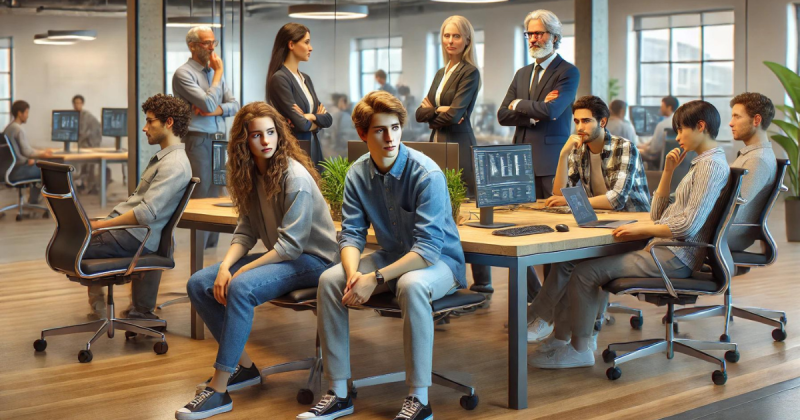
Every new generation faces its own unique set of circumstances and challenges. As the years and decades pass by, society itself can’t help but change and evolve. This constant state of flux across both civilization and culture usually results in dramatically different views and opinions between generations. After all, someone born in 1970 probably isn’t going to see and perceive the world the same way as another person born in 1997.
While the notion of a generational divide is hardly a new concept in general, the dichotomy among generations of Americans is often at its most apparent and undeniable in the modern workplace. Offices, businesses, and workspaces of all shapes, sizes, and kinds ask employees to spend hours upon hours within close proximity of each other, and that means generational discrepancies and misunderstandings are bound to occur.
The 2024 edition of the Work in America survey, put together by The American Psychological Association and The Harris Poll, provides a unique and timely take on the dynamics among different generations of workers across America’s workplaces. Let’s take a closer look at its findings.
Younger employees: feeling lonely and unappreciated
After surveying over 2,000 adult working Americans, researchers say two of the biggest takeaways this year is that younger employees are struggling mightily with feelings of isolation and loneliness, and those same younger workers tend to be much more comfortable working alongside coworkers close to their own age.
More specifically, the survey tells us 3 in 10 (32%) polled workers said that those in their organization who are not close to their age fail to see the value in their ideas. Crucially, this sentiment is much more common among people aged 18–25 (48%) compared to others aged 65 and older (16%). Similarly, younger and middle-aged respondents (ages 18–25, 26–43 years old) were much more likely than their older colleagues (ages 44-65+) to tell researchers they are more comfortable working with people their own age.
The poll also suggests younger Americans in the workforce are struggling to form meaningful connections and friendships with their colleagues. Close to half of all surveyed workers (42%) between ages 18 and 25 said they feel lonely on the job! Younger demographics of American workers are also more likely to report feeling tense or stressed out during a typical workday.
“With more workers retiring later in life, the demographics of the workplace are changing and younger workers seem to be having the hardest time adjusting. At the same time, with increased remote work and the use of new technologies like AI, younger and older workers alike are facing a paradigm shift around where and how we work,” says Arthur C. Evans Jr., Ph.D., APA’s chief executive officer, in a press release.
“To remain competitive, employers should invest in strategies that support their workers’ well-being and mental health to help them navigate these new norms and evolving professional landscape.”
Modern workers strive for more control
In life, it’s usually best to keep one’s own hands on the steering wheel. The survey suggests many American workers wish they had just a little more control over their day to day work scenarios, assignments, and locations. A third of employees believe they do not have enough control over when, where, and how they perform their work. Meanwhile, one in three workers (33%) added they currently aren’t working in their ideal work location (whether that be totally remote, hybrid, or on-site).
Speaking of where Americans are working in 2024, 59% of polled employees are still reporting to a physical job location on a full-time basis, 24% are following a hybrid schedule, and 17% have gone entirely remote. However, when respondents were asked where they’d like to work given a choice, the numbers shaked out very differently; 38% prefer on-location, 34% would choose a hybrid arrangement, and 28% want to work on a remote basis.
Additional noteworthy findings:
- four-day work weeks are on the rise: The coveted four-day work week continues to become more and more common with each passing year. This year 22% of workers said their employer offers such an arrangement – compared to 17% in 2023 and 14% in 2022.
- Employees are adopting AI faster than employers: While over a third (35%) of employees report using AI to help with various tasks, just 18% said their employer actually has an official policy regarding the acceptable uses of AI.
- Burnout is troublingly common: Most (67%) workers have experienced at least one symptom associated with work burnout over the prior month. Examples include loneliness, lack of motivation, and low energy levels.
Speaking one’s mind does wonders for mental health
It’s never been more clear than today just how vital employee mental health is to organizational wellbeing. Employees who said they were comfortable speaking freely on the job (expressing themselves, bringing up a tough problem, etc) without having to worry about negative consequences usually reported having a much better time at work in general.
Also known as psychological safety, the research team stresses the importance of a positive workplace and company culture when it comes to worker wellbeing and mental health. Surveyed Americans who reported high levels of on-the-job psychological safety were much more likely to say they feel like they belong (95% vs. 69%), and that they are comfortable being themselves at work (95% vs. 75%). Those same workers are also roughly 10x less likely to see where they work as a toxic place compared to other professionals experiencing lower levels of psychological safety (3% vs. 30%).
“Our survey findings underscore the need for employers to create psychologically safe work environments for their employees,” Evans concludes. “We know from research that psychological safety not only enhances individual employee well-being but strengthens the organization by fostering a culture of creativity, innovation and effective teamwork, which ultimately helps to improve the bottom line.”