'%3e %3cpath d='M15.9571 0.231934L0.147583 9.39139V32.66L15.9571 41.8195L31.7665 32.66V9.39139L15.9571 0.231934ZM15.9571 33.0172L7.68318 28.2206V13.7798L15.9571 9.00869V23.424L24.2309 28.2206L15.9571 33.0172Z' fill='%23170E30'/%3e %3cpath d='M107.275 23.3727C107.275 22.9645 107.275 22.6073 107.275 22.2756C107.275 21.6377 107.021 20.311 106.766 19.7242C104.628 14.6214 96.3791 15.5144 95.5645 21.3316C94.648 28.0417 102.438 30.9248 106.613 26.2302L104.678 24.929C102.464 26.8936 98.9759 26.5619 98.2885 23.3982H106.384H107.275V23.3727ZM98.2885 21.3826C99.0268 17.9382 103.966 17.7596 104.449 21.3826H98.2885ZM58.472 16.5095C53.9914 15.7441 51.1147 19.1629 51.522 23.4492C51.9802 28.0672 57.8865 30.2614 61.0688 26.766V28.1438H63.9964V16.3309C63.9964 16.3309 61.1706 17.9638 61.0433 18.0403C61.0433 18.0403 59.7959 16.7391 58.472 16.5095ZM57.3264 25.822C53.5077 25.3883 53.5332 19.6987 57.0464 19.1119C62.469 18.1934 62.5963 26.4088 57.3264 25.822ZM126.929 25.4648C126.471 29.5981 118.197 29.3429 116.924 25.6944L119.011 24.4698C119.597 26.1537 122.881 27.1487 123.95 25.6944C125.274 23.9085 121.048 23.4747 120.055 23.092C118.91 22.6328 117.586 21.8419 117.408 20.5151C116.72 15.5655 124.765 14.9786 126.623 18.6781L124.689 19.8263C124.103 18.2954 120.157 17.479 120.284 19.6222C120.361 20.8468 123.517 21.204 124.561 21.6633C126.318 22.4287 127.132 23.4747 126.929 25.4648ZM90.5492 18.2954C87.2142 14.3918 81.3334 16.8667 80.8497 21.7908C80.3151 27.4294 86.5523 30.8993 90.5238 26.6129V28.1438H93.2987V12.1211H90.5238V18.2699L90.5492 18.2954ZM87.7998 25.7965C83.1409 26.5874 82.2499 19.7497 86.4759 19.0864C91.2366 18.3465 92.0003 25.0566 87.7998 25.7965ZM75.8599 18.2954L74.918 17.3004C70.0555 14.3408 65.0657 19.0098 66.4404 24.2402C67.4333 28.0162 72.2958 29.9808 75.3253 27.2253C75.5544 27.0212 75.6053 26.6895 75.8599 26.6129V28.1438H78.6348V12.1211H75.8599V18.2699V18.2954ZM73.1104 25.7965C68.3752 26.4854 67.7897 19.7497 71.8121 19.1119C76.7 18.321 77.311 25.2097 73.1104 25.7965ZM112.392 16.6115H109.465V28.1693H112.392V21.102L115.6 19.2394V16.3054C114.709 16.8156 112.876 17.8872 112.392 18.1679V16.6115ZM42.4335 25.3883H49.969V28.1693H39.353V13.7795H42.4335V25.3883Z' fill='%23170E30'/%3e %3c/g%3e %3cdefs%3e %3cclipPath id='clip0_1_15718'%3e %3crect width='127' height='42' fill='white'/%3e %3c/clipPath%3e %3c/defs%3e %3c/svg%3e)

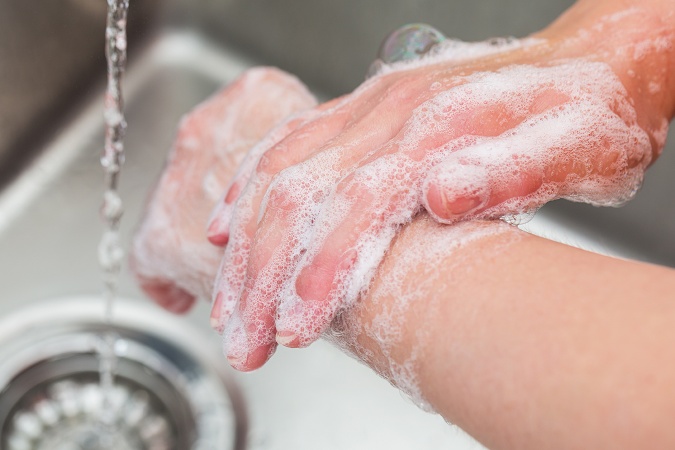
Hand washing has always been important. Hopefully, that isn’t up for debate. Still, the past year and a half or so have really driven home that importance. Since the early days of the pandemic you’ve heard it time and time again: Wash your hands!
If you’re still unsure as to exactly how long you should be spending by the faucet, a new study from the American Institute of Physics has an answer for you. At least 20 seconds.
Why 20 seconds?
It’s common knowledge that regular hand washing is the easiest and most efficient way to mitigate the spread of various diseases and infections (not just COVID-19). This latest research, however, is among the first to investigate the actual physics that occurs each time we clean our hands. Via a simple (in terms of physics) model study authors were able to simulate the key mechanics of hand washing.
This mathematical model consists of two dimensions: One “wavy surface” moving past a second wavy surface, along with a thin film of liquid between the two surfaces. That last sentence has probably left you confused, but all you really need to know is that the two surfaces represent hands, and the thin film of liquid recreates a running faucet. This setup allowed the research team to estimate the length of time it takes for a given particle, such as a bacteria or virus, to be washed off of a hand.
Now, the model showed that particles tend to get stuck within the rough surfaces of the human hand. Rough surfaces in this case refer to tiny indentations across human skin. Study authors liken this process to the particle being trapped at the bottom of a valley. When we wash our hands, there needs to be enough energy from the water flow to pick up the particle and wash it out of the “valley.”
It isn’t as simple as placing your hand under running water, though. Water flow and pressure during washing is determined by the speed of the moving hands. And, a stronger water flow means particles are removed more easily.
“Basically, the flow tells you about the forces on the particles,” explains study author Paul Hammond. “Then you can work out how the particles move and figure out if they get removed.”
Hammond uses the analogy of scrubbing a stain out of an article of clothing. The harder you scrub the faster the stain will disappear. “If you move your hands too gently, too slowly, relative to one another, the forces created by the flowing fluid are not big enough to overcome the force holding the particle down,” he adds.
The right way to wash your hands
So, it’s definitely a good idea to add some pep to your hand washing. Don’t just idly leave your hands under the faucet. It just might rid you of that one lingering disease particle that’s holding on for its viral life.
Even if you are moving your hands frantically it still takes some time for the particles to move on. The Centers for Disease Control and Prevention recommend that a handwashing session last at least 20 seconds.
This work reinforces that recommendation. The mathematical model showed that it takes at least 20 seconds of diligent hand washing for particles to dislodge from the skin. That means that you should probably be spending upwards of 30 seconds to a full minute under the faucet – especially if you aren’t moving your hands much.
Next on Hammond’s agenda is how soap plays into all of this. More specifically, if these new revelations regarding how disease-causing particles are removed from the hands may aid in the creation of new and more effective, environmentally friendly soaps.
“Nowadays, we need to be a bit more thoughtful about what happens to the wash chemicals when they go down the plughole and enter the environment,” Hammond adds.
The full study can be found here, published in Physics of Fluids.