'%3e %3cpath d='M15.9571 0.231934L0.147583 9.39139V32.66L15.9571 41.8195L31.7665 32.66V9.39139L15.9571 0.231934ZM15.9571 33.0172L7.68318 28.2206V13.7798L15.9571 9.00869V23.424L24.2309 28.2206L15.9571 33.0172Z' fill='%23170E30'/%3e %3cpath d='M107.275 23.3727C107.275 22.9645 107.275 22.6073 107.275 22.2756C107.275 21.6377 107.021 20.311 106.766 19.7242C104.628 14.6214 96.3791 15.5144 95.5645 21.3316C94.648 28.0417 102.438 30.9248 106.613 26.2302L104.678 24.929C102.464 26.8936 98.9759 26.5619 98.2885 23.3982H106.384H107.275V23.3727ZM98.2885 21.3826C99.0268 17.9382 103.966 17.7596 104.449 21.3826H98.2885ZM58.472 16.5095C53.9914 15.7441 51.1147 19.1629 51.522 23.4492C51.9802 28.0672 57.8865 30.2614 61.0688 26.766V28.1438H63.9964V16.3309C63.9964 16.3309 61.1706 17.9638 61.0433 18.0403C61.0433 18.0403 59.7959 16.7391 58.472 16.5095ZM57.3264 25.822C53.5077 25.3883 53.5332 19.6987 57.0464 19.1119C62.469 18.1934 62.5963 26.4088 57.3264 25.822ZM126.929 25.4648C126.471 29.5981 118.197 29.3429 116.924 25.6944L119.011 24.4698C119.597 26.1537 122.881 27.1487 123.95 25.6944C125.274 23.9085 121.048 23.4747 120.055 23.092C118.91 22.6328 117.586 21.8419 117.408 20.5151C116.72 15.5655 124.765 14.9786 126.623 18.6781L124.689 19.8263C124.103 18.2954 120.157 17.479 120.284 19.6222C120.361 20.8468 123.517 21.204 124.561 21.6633C126.318 22.4287 127.132 23.4747 126.929 25.4648ZM90.5492 18.2954C87.2142 14.3918 81.3334 16.8667 80.8497 21.7908C80.3151 27.4294 86.5523 30.8993 90.5238 26.6129V28.1438H93.2987V12.1211H90.5238V18.2699L90.5492 18.2954ZM87.7998 25.7965C83.1409 26.5874 82.2499 19.7497 86.4759 19.0864C91.2366 18.3465 92.0003 25.0566 87.7998 25.7965ZM75.8599 18.2954L74.918 17.3004C70.0555 14.3408 65.0657 19.0098 66.4404 24.2402C67.4333 28.0162 72.2958 29.9808 75.3253 27.2253C75.5544 27.0212 75.6053 26.6895 75.8599 26.6129V28.1438H78.6348V12.1211H75.8599V18.2699V18.2954ZM73.1104 25.7965C68.3752 26.4854 67.7897 19.7497 71.8121 19.1119C76.7 18.321 77.311 25.2097 73.1104 25.7965ZM112.392 16.6115H109.465V28.1693H112.392V21.102L115.6 19.2394V16.3054C114.709 16.8156 112.876 17.8872 112.392 18.1679V16.6115ZM42.4335 25.3883H49.969V28.1693H39.353V13.7795H42.4335V25.3883Z' fill='%23170E30'/%3e %3c/g%3e %3cdefs%3e %3cclipPath id='clip0_1_15718'%3e %3crect width='127' height='42' fill='white'/%3e %3c/clipPath%3e %3c/defs%3e %3c/svg%3e)

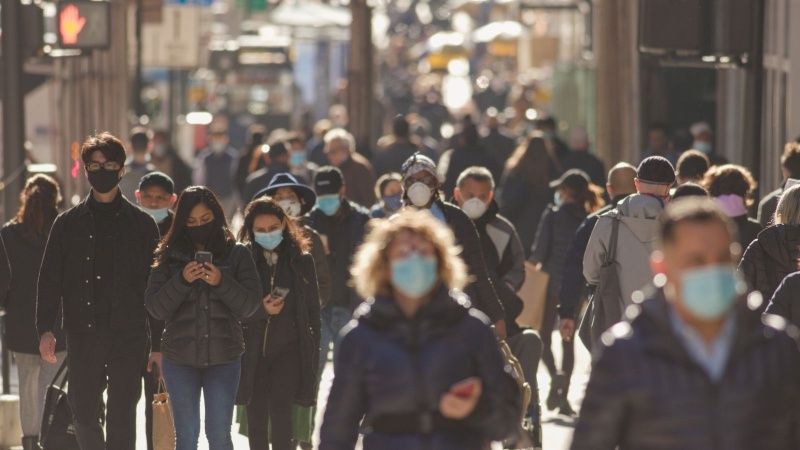
Celine Gounder, MD, an epidemiologist and infectious disease specialist at Bellevue Hospital Center in New York City, recently told The New York Times that although we won’t see as many COVID-induced deaths and hospitalizations this year as we saw last year, the country probably won’t be fully back to normal until some time next spring.
Why is the pandemic end date so far away?
Despite improved vaccine rollout in the U.S. and federal authorization for booster shots in the fall, most indicators suggest the COVID-19 pandemic won’t be ending any time soon. This estimation is primarily informed by the new more transmissive Delta strain and back-to-school season.
“A lot of schools across the country are just not taking this very seriously this year,” Dr.Gounder told The Times. “So you will see transmission from schools back into the community.”
According to research published in the journal JAMA Pediatrics, young children are reliable vectors for the novel coronavirus (SARS-CoV-2) because they require direct care from older members of their households and are not old enough themselves to receive a vaccine.
Variants complicate recovery efforts
Dr. Gounder is not alone in her less than optimistic pandemic projection. Other leading virologists are concerned that the rapid pace at which SARS-CoV-2 mutates may blunt the efficacy of vaccines and clinical therapeutics in the future.
We’ve already seen this to some degree. All of the vaccines that are available to the public work against the Delta variant, but not as well as they do against previously documented strains.
Various news outlets have been reporting on a growing number of vaccinated people who tested positive for Delta—the strain that accounts for 99% of new cases in the U.S.
“The nature of Delta transmission means that the cases are going to go up in a lot of places at around the same time, but the consequences will be much, much worse in terms of absolute numbers in places with less vaccination,” Bill Hanage, MD, an epidemiologist at the Harvard T.H. Chan School of Public Health explained.
The plan for booster shots
COVID-19 booster shots of the Pfizer and Moderna vaccines are set to become available for all U.S. adults beginning this month.
During a recent White House Briefing, Dr. Vivek Murthy, the surgeon general, said that national health systems will try to ensure disproportionately affected populations have early access to booster shots in order to reduce the burden placed on hospitals ahead of surging cases.
“This includes our most vulnerable populations, like our health care providers, nursing home residents, and other seniors. We will also begin delivering booster shots directly to residents of long-term care facilities,” Dr. Murthy said.
There has been a noted pattern of decline in immunity for patients who received vaccine doses six months ago. This is expected to continue, as it’s still unclear how many vaccinated people plan on scheduling an appointment for a booster shot this year.
While vaccine efficacy is waning, new variants are emerging with properties that threaten the trajectory of national recovery.
Earlier this week, The World Health Organization (WHO) identified a new strain of the novel coronavirus called Mu, as a variant of interest.
Mu may induce more severe disease in affected populations, be more transmissible, and potentially more resistant to vaccines and therapeutics compared to previously documented strains.
Booster shots alone are not expected to curb the inclining rate of infections. Delta (India), like Mu (Columbia), originated in foreign countries. Emerging variants will have to be addressed on a global stage to protect any one nation in the long run.
Vaccinologists posit that we need 4 billion to 5 billion doses to immunize the world’s low- and middle-income countries by the end of 2021 in order to meaningfully bring cases down worldwide.
“The pandemic must be addressed globally — both on humanitarian grounds and for our self-interest in preventing the emergence of other variants,” the Los Angeles Times reports. “But so far, the U.S. government has not moved fast enough on setting a strategy for vaccinating the world, besides making some modest donations of vaccine doses and loosening of patent restrictions.”
How back-to-school season will impact cases
According to the American Academy of Pediatrics, the U.S. saw child cases increase from about 38,000 the week ending July 22 to more than 200,000 reported this past week. These numbers are continuing to increase.
Alongside COVID, children are contracting common respiratory syncytial viruses (RSV) as well.
“Because the absolute number of cases is so high, the absolute number of children who are coming into the hospital is high. It’s also the case that we are currently within a surge of RSV cases as well, respiratory syncytial virus cases,” Centers for Disease Control and Prevention (CDC) Director Dr. Rochelle Walensky said at a news briefing last week. “We’re seeing RSV rates similar to what we generally see in the winter months.”
The CDC recommends that all students, staff, teachers, and visitors to K-12 schools, regardless of vaccination status, wear masks while indoors. “I can tell you that most of the places where we’re seeing surges and outbreaks are in places that are not implementing our current guidance,” Walensky continued.
Some school districts are requiring their staff to show proof of vaccination before returning to work.
Dr. Anthony Fauci says that vaccines may be available for children under 12 before the holidays roll around again.
“I believe that mandating vaccines for children to appear in school is a good idea,” Fauci told CNN’s Jake Tapper on “State of the Union” Sunday. “We’ve done this for decades and decades, requiring polio, measles, mumps, rubella, hepatitis [vaccinations].”
The U.S. Department of Education is currently investigating five states – Iowa, Oklahoma, South Carolina, Tennessee, and Utah, to determine whether or not their masks bans could potentially cause students with disabilities and underlying health conditions to be more vulnerable to COVID-19.
The end of COVID…but when?
In the event that COVID-19 ends up being endemic, or regularly occurring at certain seasons, the end of the pandemic will be marked by things other than case numbers.
Even now, many experts track the progress of our health crisis with consumer measures. In other words, a healthy box office, full airplanes, and busy restaurants may come before the novel coronavirus is eradicated completely.
Ideally, this would mean vaccines and health guidance is efficient enough to keep COVID hospitalizations and deaths very low.
It’s understandable that Americans are looking for some kind of signal that business can continue as usual, but the variables are too numerous to say anything conclusively at any one juncture.
“We can get through this winter and get, really, the majority—overwhelming majority—of the 90 million people who have not been vaccinated, vaccinated, I hope we can start to get some good control in the spring of 2022,” Dr. Fauci continued.
“As we get into the spring, we could start getting back to a degree of normality, namely reassuming the things that we were hoping we could do—restaurants, theaters, that kind of thing.”
Read more about COVID variants here.