'%3e %3cpath d='M15.9571 0.231934L0.147583 9.39139V32.66L15.9571 41.8195L31.7665 32.66V9.39139L15.9571 0.231934ZM15.9571 33.0172L7.68318 28.2206V13.7798L15.9571 9.00869V23.424L24.2309 28.2206L15.9571 33.0172Z' fill='%23170E30'/%3e %3cpath d='M107.275 23.3727C107.275 22.9645 107.275 22.6073 107.275 22.2756C107.275 21.6377 107.021 20.311 106.766 19.7242C104.628 14.6214 96.3791 15.5144 95.5645 21.3316C94.648 28.0417 102.438 30.9248 106.613 26.2302L104.678 24.929C102.464 26.8936 98.9759 26.5619 98.2885 23.3982H106.384H107.275V23.3727ZM98.2885 21.3826C99.0268 17.9382 103.966 17.7596 104.449 21.3826H98.2885ZM58.472 16.5095C53.9914 15.7441 51.1147 19.1629 51.522 23.4492C51.9802 28.0672 57.8865 30.2614 61.0688 26.766V28.1438H63.9964V16.3309C63.9964 16.3309 61.1706 17.9638 61.0433 18.0403C61.0433 18.0403 59.7959 16.7391 58.472 16.5095ZM57.3264 25.822C53.5077 25.3883 53.5332 19.6987 57.0464 19.1119C62.469 18.1934 62.5963 26.4088 57.3264 25.822ZM126.929 25.4648C126.471 29.5981 118.197 29.3429 116.924 25.6944L119.011 24.4698C119.597 26.1537 122.881 27.1487 123.95 25.6944C125.274 23.9085 121.048 23.4747 120.055 23.092C118.91 22.6328 117.586 21.8419 117.408 20.5151C116.72 15.5655 124.765 14.9786 126.623 18.6781L124.689 19.8263C124.103 18.2954 120.157 17.479 120.284 19.6222C120.361 20.8468 123.517 21.204 124.561 21.6633C126.318 22.4287 127.132 23.4747 126.929 25.4648ZM90.5492 18.2954C87.2142 14.3918 81.3334 16.8667 80.8497 21.7908C80.3151 27.4294 86.5523 30.8993 90.5238 26.6129V28.1438H93.2987V12.1211H90.5238V18.2699L90.5492 18.2954ZM87.7998 25.7965C83.1409 26.5874 82.2499 19.7497 86.4759 19.0864C91.2366 18.3465 92.0003 25.0566 87.7998 25.7965ZM75.8599 18.2954L74.918 17.3004C70.0555 14.3408 65.0657 19.0098 66.4404 24.2402C67.4333 28.0162 72.2958 29.9808 75.3253 27.2253C75.5544 27.0212 75.6053 26.6895 75.8599 26.6129V28.1438H78.6348V12.1211H75.8599V18.2699V18.2954ZM73.1104 25.7965C68.3752 26.4854 67.7897 19.7497 71.8121 19.1119C76.7 18.321 77.311 25.2097 73.1104 25.7965ZM112.392 16.6115H109.465V28.1693H112.392V21.102L115.6 19.2394V16.3054C114.709 16.8156 112.876 17.8872 112.392 18.1679V16.6115ZM42.4335 25.3883H49.969V28.1693H39.353V13.7795H42.4335V25.3883Z' fill='%23170E30'/%3e %3c/g%3e %3cdefs%3e %3cclipPath id='clip0_1_15718'%3e %3crect width='127' height='42' fill='white'/%3e %3c/clipPath%3e %3c/defs%3e %3c/svg%3e)

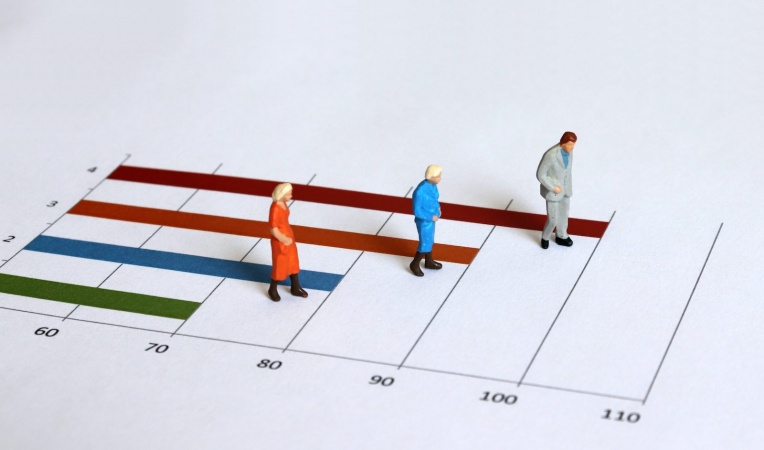
The person with the longest lifespan on record was a French woman named Jeanne Calment; she lived to be 122 years and 164 days old. Today, the world’s oldest living person is 118-year-old Kane Tanaka of Japan.
While you may not fare so well, the likelihood of living to 110 or older in the next 80 years has increased, according to a scientific paper published last month in Demographic Research, a science journal published by the Max Planck Institute for Demographic Research in Germany.
The paper, written by scientists from the University of Washington, used mathematically modeled data provided by the International Database on Longevity (IDL).
Using IDL data collected from 13 countries, including the US, the researchers tracked the extreme longevity of centenarians (people 100 to 110 years old) and supercentenarians (people more than 110 years old).
According to the IDL, as of August 2017, it had “records on 1,304 validated supercentenarians and 18,590 semi-supercentenarians from 15 countries.”
The first person in its verified database who lived to age 110 was born in 1852 and died in 1962 in Quebec, while the last person in its database to live to 110 was born in 1906 and reached that milestone in 2016.
Breaking longevity records
Michael Pearce, one of the study’s authors and a PhD student at the University of Washington, believes it’s “extremely likely” someone will break Calment’s longevity record by the end of this century.
Utilizing Bayesian analysis, a statistical theory that measures the probability of a future event, the study’s authors concluded:
- There is a greater than 99% probability that the current longevity record of 122 years will be broken by 2100.
- The probability that at least one person will live to 126 in the next century is 89%.
- The likelihood that at least one person will live to 128 over the same period is 44%.
- There is a 13% chance that at least one person will live to 130 in the next 100 years.
What’s causing longer lifespans?
The many advances in education, science, public health, medicine and the biology of aging in recent years may all be contributing to longer lifespans.
These advances are so numerous, some scientists believe a “cure” for aging will be discovered in the not-too-distant future.
In pursuit of this goal, scientists are zeroing in on “senescent cells,” aging cells that stop dividing and making new cells. Instead, they linger, releasing chemicals that are unhelpful to the functioning of normal cells and cause inflammation. While senescent cells increase with age, recent experiments have shown they can be removed from mice in laboratory settings, which could one day lead to treatments that offer longer lifespans to humans.
Scientist Andrew Steele, the author of “Ageless: The New Science of Getting Older Without Getting Old,” believes it’s possible that some who are alive today could live to be 120 or older within the next 100 years.
“I think there’s the potential for far more exciting breakthroughs by targeting the aging process rather than particular diseases,” Steele told CNBC Make it.
Other studies on aging are ongoing. One such study published in May examined subjects’ blood to search for telltale biological markers of aging. The researchers who conducted this study are so encouraged by their findings, they believe it may be possible for disease-free humans who live in stress-free environments to live for up to 150 years.
Steps you can take to increase the odds of living a longer life
Dan Buettner, a National Geographic Fellow and journalist, believes there are some healthy habits that can increase the likelihood of longevity. These habits include:
- Having at least three close friends who you can count on for emotional support.
- A daily walking routine.
- Taking a 20-minute nap five days a week.
In addition, a 2018 Harvard study found that the following five habits increased life expectancy by up to 10 years:
- Eating a high-quality healthy diet
- 30 minutes (or more) a day of moderate to vigorous physical activity
- Maintaining a healthy body weight
- Avoiding large amounts of alcohol
- Not smoking
Other current research indicates that eating two servings of fruit and three servings of vegetables a day correlates with lower death rates.