'%3e %3cpath d='M15.9571 0.231934L0.147583 9.39139V32.66L15.9571 41.8195L31.7665 32.66V9.39139L15.9571 0.231934ZM15.9571 33.0172L7.68318 28.2206V13.7798L15.9571 9.00869V23.424L24.2309 28.2206L15.9571 33.0172Z' fill='%23170E30'/%3e %3cpath d='M107.275 23.3727C107.275 22.9645 107.275 22.6073 107.275 22.2756C107.275 21.6377 107.021 20.311 106.766 19.7242C104.628 14.6214 96.3791 15.5144 95.5645 21.3316C94.648 28.0417 102.438 30.9248 106.613 26.2302L104.678 24.929C102.464 26.8936 98.9759 26.5619 98.2885 23.3982H106.384H107.275V23.3727ZM98.2885 21.3826C99.0268 17.9382 103.966 17.7596 104.449 21.3826H98.2885ZM58.472 16.5095C53.9914 15.7441 51.1147 19.1629 51.522 23.4492C51.9802 28.0672 57.8865 30.2614 61.0688 26.766V28.1438H63.9964V16.3309C63.9964 16.3309 61.1706 17.9638 61.0433 18.0403C61.0433 18.0403 59.7959 16.7391 58.472 16.5095ZM57.3264 25.822C53.5077 25.3883 53.5332 19.6987 57.0464 19.1119C62.469 18.1934 62.5963 26.4088 57.3264 25.822ZM126.929 25.4648C126.471 29.5981 118.197 29.3429 116.924 25.6944L119.011 24.4698C119.597 26.1537 122.881 27.1487 123.95 25.6944C125.274 23.9085 121.048 23.4747 120.055 23.092C118.91 22.6328 117.586 21.8419 117.408 20.5151C116.72 15.5655 124.765 14.9786 126.623 18.6781L124.689 19.8263C124.103 18.2954 120.157 17.479 120.284 19.6222C120.361 20.8468 123.517 21.204 124.561 21.6633C126.318 22.4287 127.132 23.4747 126.929 25.4648ZM90.5492 18.2954C87.2142 14.3918 81.3334 16.8667 80.8497 21.7908C80.3151 27.4294 86.5523 30.8993 90.5238 26.6129V28.1438H93.2987V12.1211H90.5238V18.2699L90.5492 18.2954ZM87.7998 25.7965C83.1409 26.5874 82.2499 19.7497 86.4759 19.0864C91.2366 18.3465 92.0003 25.0566 87.7998 25.7965ZM75.8599 18.2954L74.918 17.3004C70.0555 14.3408 65.0657 19.0098 66.4404 24.2402C67.4333 28.0162 72.2958 29.9808 75.3253 27.2253C75.5544 27.0212 75.6053 26.6895 75.8599 26.6129V28.1438H78.6348V12.1211H75.8599V18.2699V18.2954ZM73.1104 25.7965C68.3752 26.4854 67.7897 19.7497 71.8121 19.1119C76.7 18.321 77.311 25.2097 73.1104 25.7965ZM112.392 16.6115H109.465V28.1693H112.392V21.102L115.6 19.2394V16.3054C114.709 16.8156 112.876 17.8872 112.392 18.1679V16.6115ZM42.4335 25.3883H49.969V28.1693H39.353V13.7795H42.4335V25.3883Z' fill='%23170E30'/%3e %3c/g%3e %3cdefs%3e %3cclipPath id='clip0_1_15718'%3e %3crect width='127' height='42' fill='white'/%3e %3c/clipPath%3e %3c/defs%3e %3c/svg%3e)

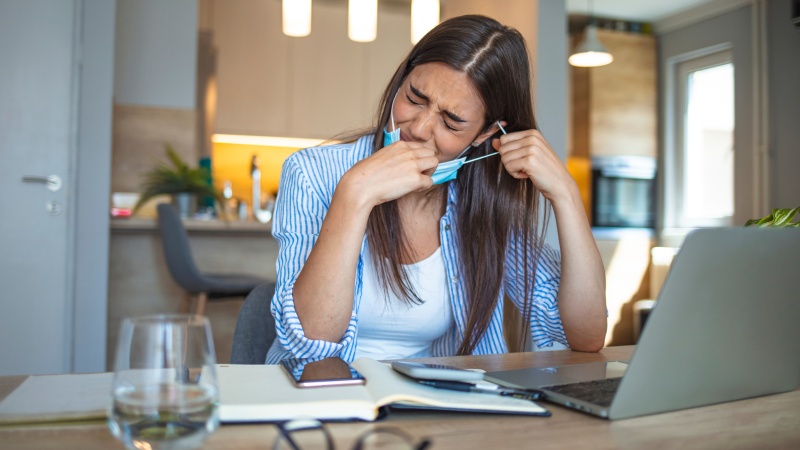
• Also known as “long haulers,” COVID-19 survivors continue to suffer side effects more than a year later.
• Shortness of breath is the most common symptom.
• Anxiety and depression also grew within 12 months of diagnosis.
Roughly half of COVID-19 survivors have still experienced at least one symptom a year after being released from the hospital, according to a new study.
People in this group, sometimes described as “long haulers,” continue to suffer side effects — both physically and mentally.
The study, led by researchers at Capital Medical University in Beijing, looked at patients in Wuhan, China, where the outbreak began in late 2019. It found that 68% of patients still had at least one persistent COVID-19 symptom after being released from the hospital, but patients complaining about shortness of breath rose between a 12-month period, from 26% to 30%.
“We found that most patients had a good physical and functional recovery during follow-up, and the majority of study participants who were employed before COVID-19 had returned to their original work,” researchers said in the study published in The Lancet.
“However, sequelae symptoms, lung diffusion impairment, and radiographic abnormalities persisted to 12 months in some patients, especially in patients who were critically ill during hospital stay.”
Mental and physical pain linger
COVID-19 long haulers have become a legitimate health concern in the U.S, which President Biden recently announced would be covered under federal disability law. The symptoms cited in the announcement — like lingering issues with breathing, brain fog, chronic pain or fatigue — are similar to what patients in China experienced long after getting sick with COVID-19.
The researchers interviewed COVID-19 survivors six and 12 months after symptom onset between January and May 2020. Nearly half (49%) complained about sleep problems, heart palpitations, joint pain or chest pain 12 months later. Women, especially, suffered worsening odds of feeling fatigue or muscle weakness, according to the study.
In addition, mental health conditions deteriorated during the time period. More patients reported anxiety or depression at 12 months compared to six months; the number rose from 23% to 26%.
Compared to a general population, the percentage of patients experiencing anxiety or depression is much larger (26% versus 5%).
“We do not yet fully understand why psychiatric symptoms are slightly more common at one year than at six months in COVID-19 survivors,” said Xiaoying Gu, one of the authors of the study.
“These could be caused by a biological process linked to the virus infection itself, or the body’s immune response to it. Or they could be linked to reduced social contact, loneliness, incomplete recovery of physical health or loss of employment associated with illness. Large, long-term studies of COVID-19 survivors are needed so that we can better understand the long-term physical and mental health consequences of COVID-19.”
Some people never return to work
Work was also impacted by people experiencing long-term COVID symptoms.
Twelve percent of people in the study said they didn’t return to work after falling ill, citing decreased physical function as the most popular reason. However, most of the 1,276 patients interviewed did return to their pre-COVID-19 level of work within 12 months, according to the study.
For more on COVID-19: U.S. probing whether Moderna vaccine is linked to higher heart inflammation risk.