'%3e %3cpath d='M15.9571 0.231934L0.147583 9.39139V32.66L15.9571 41.8195L31.7665 32.66V9.39139L15.9571 0.231934ZM15.9571 33.0172L7.68318 28.2206V13.7798L15.9571 9.00869V23.424L24.2309 28.2206L15.9571 33.0172Z' fill='%23170E30'/%3e %3cpath d='M107.275 23.3727C107.275 22.9645 107.275 22.6073 107.275 22.2756C107.275 21.6377 107.021 20.311 106.766 19.7242C104.628 14.6214 96.3791 15.5144 95.5645 21.3316C94.648 28.0417 102.438 30.9248 106.613 26.2302L104.678 24.929C102.464 26.8936 98.9759 26.5619 98.2885 23.3982H106.384H107.275V23.3727ZM98.2885 21.3826C99.0268 17.9382 103.966 17.7596 104.449 21.3826H98.2885ZM58.472 16.5095C53.9914 15.7441 51.1147 19.1629 51.522 23.4492C51.9802 28.0672 57.8865 30.2614 61.0688 26.766V28.1438H63.9964V16.3309C63.9964 16.3309 61.1706 17.9638 61.0433 18.0403C61.0433 18.0403 59.7959 16.7391 58.472 16.5095ZM57.3264 25.822C53.5077 25.3883 53.5332 19.6987 57.0464 19.1119C62.469 18.1934 62.5963 26.4088 57.3264 25.822ZM126.929 25.4648C126.471 29.5981 118.197 29.3429 116.924 25.6944L119.011 24.4698C119.597 26.1537 122.881 27.1487 123.95 25.6944C125.274 23.9085 121.048 23.4747 120.055 23.092C118.91 22.6328 117.586 21.8419 117.408 20.5151C116.72 15.5655 124.765 14.9786 126.623 18.6781L124.689 19.8263C124.103 18.2954 120.157 17.479 120.284 19.6222C120.361 20.8468 123.517 21.204 124.561 21.6633C126.318 22.4287 127.132 23.4747 126.929 25.4648ZM90.5492 18.2954C87.2142 14.3918 81.3334 16.8667 80.8497 21.7908C80.3151 27.4294 86.5523 30.8993 90.5238 26.6129V28.1438H93.2987V12.1211H90.5238V18.2699L90.5492 18.2954ZM87.7998 25.7965C83.1409 26.5874 82.2499 19.7497 86.4759 19.0864C91.2366 18.3465 92.0003 25.0566 87.7998 25.7965ZM75.8599 18.2954L74.918 17.3004C70.0555 14.3408 65.0657 19.0098 66.4404 24.2402C67.4333 28.0162 72.2958 29.9808 75.3253 27.2253C75.5544 27.0212 75.6053 26.6895 75.8599 26.6129V28.1438H78.6348V12.1211H75.8599V18.2699V18.2954ZM73.1104 25.7965C68.3752 26.4854 67.7897 19.7497 71.8121 19.1119C76.7 18.321 77.311 25.2097 73.1104 25.7965ZM112.392 16.6115H109.465V28.1693H112.392V21.102L115.6 19.2394V16.3054C114.709 16.8156 112.876 17.8872 112.392 18.1679V16.6115ZM42.4335 25.3883H49.969V28.1693H39.353V13.7795H42.4335V25.3883Z' fill='%23170E30'/%3e %3c/g%3e %3cdefs%3e %3cclipPath id='clip0_1_15718'%3e %3crect width='127' height='42' fill='white'/%3e %3c/clipPath%3e %3c/defs%3e %3c/svg%3e)

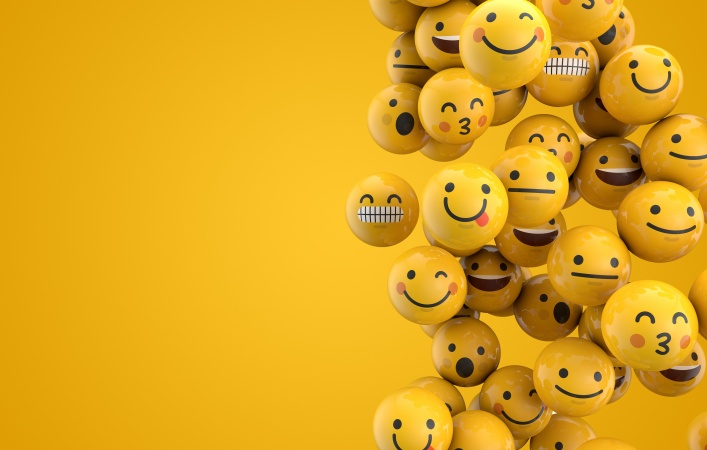
For those of us old enough to remember a world without emojis, life feels a whole lot more complicated nowadays. It isn’t enough to just type out what’s going or how you’re feeling, you’re now expected to literally animate the mundanities of everyday life.
That’s a particularly pessimistic take on the emoji. Still, there’s no denying that emojis have further complicated texting, which was already a hard medium to convey notions like sarcasm or humor. On that note, a fascinating new study is advising everyone to avoid an entire category of emojis or risk being labeled a “downer.”
Researchers from the University of Ottawa say that using a “negative emoji” of any kind is enough to have your message completely misinterpreted. According to their findings, if a negative emoji is part of a text, the sender will be perceived negatively regardless of their intentions.
“Even if you have a positive message with a negative emoji, the receiver will interpret the sender as being in a negative mood. Any reference to negativity will drive how people interpret your emotional state when you write a text message,” explains lead study author Isabelle Boutet, a Full Professor in Psychology in the Faculty of Social Sciences. “We also found certain types of messages were more difficult to convey; people have a lot of problems interpreting messages that are meant to convey irony or sarcasm.”
This emoji backlash works both ways as well. Study authors say if you pair a negative message with a happy emoji, the recipient will likely either be puzzled or unsettled.
“Emojis are consequential and have an impact on the interpretation of the sender by the receiver and if you display any form of negativity – even pairing a positive emoji with a negative message – it is going to be interpreted negatively. You are going to be perceived as a person who is cold, and you will come across as in a negative mood when using negative emojis, regardless of the tone,” Professor Boutet says.
A total of 38 local UO students took part in this research. First, the students were shown 12 different sentence-emoji pairings of varying temperaments (happy, negative, sad, etc). Importantly, some sentences were positive but included a negative emoji and vice versa. From there each participant rated the sentences in terms of the sender’s emotional state and the message the sender was trying to convey.
No one walks up to their office manager with a smile from ear to ear and proclaims they just had the worst weekend of their life. Similarly, have you ever approached a friend with a scowl on your face and said it’s great to see them? No, because that would be insane. The research team says, in light of these findings, perhaps people should start treating texts and emojis like they treat real-world face-to-face interactions.
“People often try to control the emotion they convey with their faces to avoid social conflict. Yet people use emojis for fun without giving it much thought when, in fact, they have a strong impact on interpersonal interactions,” Professor Boutet adds.
Professor Boutet and her team even wonder if the young children of today, and future generations, will slowly but surely lose the ability to pick up on facial emotions due to performing most of their communicating via text or emoji.
“The big question is do emojis act as proxies, do they engage the same mechanism as facial expressions of emotions that play a large role in face-to-face (FTF) interaction? With FTF interactions, we have – through evolution – developed very evolved mechanisms that process these facial expressions of emotions. Kids use a lot of these digital interactions and they risk losing the ability to interact FTF,” she comments.
In this writer’s opinion, people use emojis so freely and nonsensically because emojis themselves are considered nonsense. From dragons, bugs, and snowmen to everything else in emoji-land, it’s hard to take these tiny caricatures seriously. Just keep in mind that the emojis themselves may be nonsense, but the perceptions they spark aren’t.
“You should not think that emojis are a cute little thing that you add in a text message and that it has no consequence on your interaction. Emojis have a large consequence and strong impact on how your text message will be interpreted and how you will be perceived,” Boutet concludes.
The full study can be found here, published in Computers in Human Behavior.