'%3e %3cpath d='M15.9571 0.231934L0.147583 9.39139V32.66L15.9571 41.8195L31.7665 32.66V9.39139L15.9571 0.231934ZM15.9571 33.0172L7.68318 28.2206V13.7798L15.9571 9.00869V23.424L24.2309 28.2206L15.9571 33.0172Z' fill='%23170E30'/%3e %3cpath d='M107.275 23.3727C107.275 22.9645 107.275 22.6073 107.275 22.2756C107.275 21.6377 107.021 20.311 106.766 19.7242C104.628 14.6214 96.3791 15.5144 95.5645 21.3316C94.648 28.0417 102.438 30.9248 106.613 26.2302L104.678 24.929C102.464 26.8936 98.9759 26.5619 98.2885 23.3982H106.384H107.275V23.3727ZM98.2885 21.3826C99.0268 17.9382 103.966 17.7596 104.449 21.3826H98.2885ZM58.472 16.5095C53.9914 15.7441 51.1147 19.1629 51.522 23.4492C51.9802 28.0672 57.8865 30.2614 61.0688 26.766V28.1438H63.9964V16.3309C63.9964 16.3309 61.1706 17.9638 61.0433 18.0403C61.0433 18.0403 59.7959 16.7391 58.472 16.5095ZM57.3264 25.822C53.5077 25.3883 53.5332 19.6987 57.0464 19.1119C62.469 18.1934 62.5963 26.4088 57.3264 25.822ZM126.929 25.4648C126.471 29.5981 118.197 29.3429 116.924 25.6944L119.011 24.4698C119.597 26.1537 122.881 27.1487 123.95 25.6944C125.274 23.9085 121.048 23.4747 120.055 23.092C118.91 22.6328 117.586 21.8419 117.408 20.5151C116.72 15.5655 124.765 14.9786 126.623 18.6781L124.689 19.8263C124.103 18.2954 120.157 17.479 120.284 19.6222C120.361 20.8468 123.517 21.204 124.561 21.6633C126.318 22.4287 127.132 23.4747 126.929 25.4648ZM90.5492 18.2954C87.2142 14.3918 81.3334 16.8667 80.8497 21.7908C80.3151 27.4294 86.5523 30.8993 90.5238 26.6129V28.1438H93.2987V12.1211H90.5238V18.2699L90.5492 18.2954ZM87.7998 25.7965C83.1409 26.5874 82.2499 19.7497 86.4759 19.0864C91.2366 18.3465 92.0003 25.0566 87.7998 25.7965ZM75.8599 18.2954L74.918 17.3004C70.0555 14.3408 65.0657 19.0098 66.4404 24.2402C67.4333 28.0162 72.2958 29.9808 75.3253 27.2253C75.5544 27.0212 75.6053 26.6895 75.8599 26.6129V28.1438H78.6348V12.1211H75.8599V18.2699V18.2954ZM73.1104 25.7965C68.3752 26.4854 67.7897 19.7497 71.8121 19.1119C76.7 18.321 77.311 25.2097 73.1104 25.7965ZM112.392 16.6115H109.465V28.1693H112.392V21.102L115.6 19.2394V16.3054C114.709 16.8156 112.876 17.8872 112.392 18.1679V16.6115ZM42.4335 25.3883H49.969V28.1693H39.353V13.7795H42.4335V25.3883Z' fill='%23170E30'/%3e %3c/g%3e %3cdefs%3e %3cclipPath id='clip0_1_15718'%3e %3crect width='127' height='42' fill='white'/%3e %3c/clipPath%3e %3c/defs%3e %3c/svg%3e)

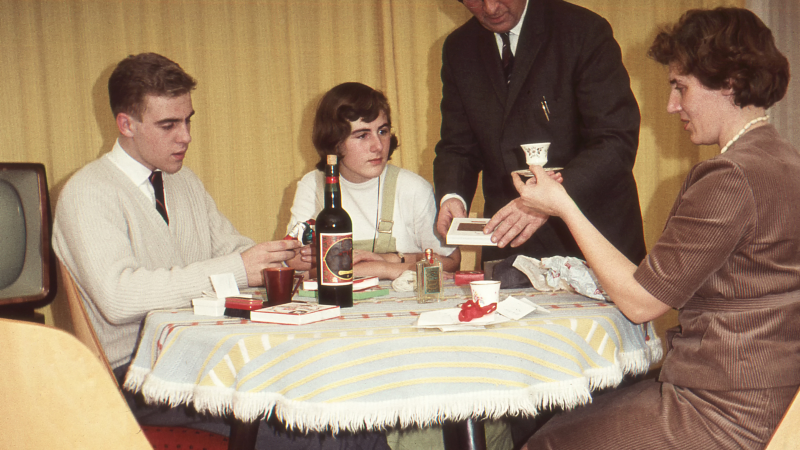
We often associate the time before microwavable meals and fast food being more wholesome and healthy—with farm fresh vegetables and fruits in abundance—but the typical 1950s American diet was actually considered to be quite high-fat and indulgent. Despite this, the average life expectancy has increased significantly from 68 years in 1950 to 81 years today, reflecting broader health trends over time.
According to a 2008 article in the Journal of the History of Medicine and Allied Sciences, the 1950s diet was largely made up with fatty meals—even predating the rise of fast food. The main meal of the day was typically substantial and often included dishes like lamb or pork chops with vegetables. Gathering around the dinner table as a family was important, with shared mealtimes leading to better academic performance and healthier lifestyle choices for children. Food rationing during and after World War II had a lasting impact on the 1950s diet, leading to higher carbohydrate intake and lower fat consumption. Common dishes included the likes of meat stews, creamed tuna, meat loaf, corned beef and cabbage, mashed potatoes with butter, breaded and fried veal cutlets, deep-fried vegetables, French fries… you get the idea.
During this time, women were encouraged to lose weight through various dieting methods. Weight-loss diets gained popularity, illustrating a societal shift towards valuing a slim figure associated with femininity. Diet advice was frequently published in women’s magazines, further promoting the trend.
Lifestyle author Anne Barone, who grew up in the 1950s in Texas, commented that the only “sanctioned pleasurable activity was eating,” adding that church family-night dinners were considered to be “food orgies.” The rising consumption of processed foods has also contributed to contemporary health issues like obesity and cardiovascular disease. The historical shift from home-cooked meals to fast foods has played a significant role in this trend. Additionally, the rise of portion sizes in fast food restaurants compared to historical standards emphasizes the importance of choosing smaller portions to reduce calorie intake.
Barone also recalled that as an overweight teenager in Texas she doesn’t remember eating hardly any fresh fruits or vegetables, with the quality of produce available in stores being extremely low—hence why canned goods, and homemade cakes, pies, and cookies reigned supreme.
With that in mind, here’s exactly what happened when I tried to follow a typical 1950s American diet for a week and why, while I love a good plate of cookies or slice of pie, I won’t be quick to give up fresh veggies any time soon.
Day One
As a strict vegetarian with relatively healthy (and modern) eating habits, I must admit I wasn’t looking forward to spending the week eating baked goods and deep fruit foods but I was still curious to see what it would be like.
I decided to pull out some old dishes from my childhood to really get into it—and committed to dinner eating at 5pm every day. I usually follow a strict intermittent fasting schedule so this was a bit of an adjustment. I made a vegan meatloaf with a side of steamed potatoes which was actually delicious but I was hungry again by 9pm.
Day Two
By day two I still had enough meatloaf to eat leftovers—which to me sounds very 1950s family style.
Eating at 5pm was definitely the most difficult thing to get used to and I decided to just lean into the idea of having a little bedtime snack around 8pm when my boyfriend was eating.
Day Three
Today is when I realized just how much the typical 1950s American diet reminded me of my childhood. I grew up in the 90s but because my grandmother lived with my family, she did a lot of the cooking when my parents were at work. We’d eat dinner every night at 5pm—sometimes even earlier—and it was always either meat and potatoes, hamburgers, stews, or macaroni and cheese.
As I sat down to eat my frozen vegan macaroni and cheese dinner after finishing my office hours for the day, I felt weirdly reminiscent eating a carb-heavy meal while it was still bright out.
Day Four
Despite my little walk down memory road, I was really craving fresh veggies by day four. I did the next best thing and cooked up canned peas, carrots, and corn, and paired it with slices of tofurkey. While it’s not necessarily an unhealthy meal, I definitely prefer fresher vegetables and am very grateful that I have easy access to an abundance of local produce.
Day Five
By the end of the week, I was looking forward to getting back to my normal salad-and-smoothie, very present-day diet. That said, I did find it rather fun to cook all these atypical meals and eat earlier in the day—especially when I realized the parallels it had with growing up with my grandmother’s cooking and the fond memories of my childhood.
Preparing for the Experiment
Before embarking on this culinary journey, I spent hours researching and preparing for the experiment. I scoured through vintage cookbooks, including my grandmother’s old recipe book, to get a sense of what people ate in the 1950s. I also read about the cultural and social context of the time, including the impact of food rationing and the rise of fast food restaurants. I made a list of ingredients and recipes that I wanted to try, and I stocked up on staples like canned peaches, cottage cheese, and frozen fruits. I also set the table with vintage china and linens to create an immersive experience.
Eating Habits Like It’s the 1950s
Eating like it’s the 1950s was a fascinating experience. I started each day with a hearty breakfast, often featuring eggs, bacon, and toast. During this era, young women began to embrace more active lifestyles, often wearing trousers and traditionally masculine garments, which influenced their dietary choices as well. I made sure to eat dinner at the table every night, just like families did back then. I tried to stick to traditional 1950s recipes, like roast beef with french fries and vegetables, and I even attempted to make some vintage desserts like pineapple upside-down cake. I also made sure to drink plenty of water and limit my intake of sugary drinks. One of the biggest challenges was avoiding processed foods, which were just starting to become popular in the 1950s. Instead, I opted for fresh fruit and vegetables, and I even tried my hand at canning and preserving.
The Impact of Processed Foods on My Health and Wellbeing
Eating like it’s the 1950s had a surprising impact on my health and wellbeing. I found that I had more energy and felt more satisfied after meals. I also noticed that my skin looked clearer and my digestion improved. I think this was due to the fact that I was eating more whole foods and avoiding processed foods, which can be high in salt, sugar, and unhealthy fats. I also found that I was sleeping better and waking up feeling more refreshed. Of course, it’s worth noting that the 1950s diet was not without its flaws – it was often high in saturated fat and low in fiber, which can increase the risk of heart disease and other health problems. However, I tried to balance out my diet by incorporating plenty of fruits, vegetables, and whole grains.
Social Aspects of Eating in the 1950s
Eating in the 1950s was a social activity that brought families and communities together. I tried to recreate this sense of community by eating dinner with my family every night and inviting friends over for dinner parties. We would often talk about our day and share stories while we ate, just like families did back then. I also noticed that eating at the dinner table helped to slow down our pace of life and encouraged us to appreciate the simple things. In an era where fast food and eating on the go are the norm, it was refreshing to take a step back and savor our meals.
Challenges and Takeaways
One of the biggest challenges of eating like it’s the 1950s was avoiding processed foods and sugary drinks. It was also difficult to find recipes that were both authentic and healthy. However, I learned a lot from this experiment and took away some valuable lessons. First, I realized the importance of eating whole foods and avoiding processed foods. I also learned that eating at the dinner table can bring families and communities together and encourage a sense of gratitude and appreciation. Finally, I discovered that even small changes to our eating habits can have a big impact on our health and wellbeing. If you’re looking to lose weight or improve your health, I would recommend trying some of these vintage recipes and incorporating more whole foods into your diet.