'%3e %3cpath d='M15.9571 0.231934L0.147583 9.39139V32.66L15.9571 41.8195L31.7665 32.66V9.39139L15.9571 0.231934ZM15.9571 33.0172L7.68318 28.2206V13.7798L15.9571 9.00869V23.424L24.2309 28.2206L15.9571 33.0172Z' fill='%23170E30'/%3e %3cpath d='M107.275 23.3727C107.275 22.9645 107.275 22.6073 107.275 22.2756C107.275 21.6377 107.021 20.311 106.766 19.7242C104.628 14.6214 96.3791 15.5144 95.5645 21.3316C94.648 28.0417 102.438 30.9248 106.613 26.2302L104.678 24.929C102.464 26.8936 98.9759 26.5619 98.2885 23.3982H106.384H107.275V23.3727ZM98.2885 21.3826C99.0268 17.9382 103.966 17.7596 104.449 21.3826H98.2885ZM58.472 16.5095C53.9914 15.7441 51.1147 19.1629 51.522 23.4492C51.9802 28.0672 57.8865 30.2614 61.0688 26.766V28.1438H63.9964V16.3309C63.9964 16.3309 61.1706 17.9638 61.0433 18.0403C61.0433 18.0403 59.7959 16.7391 58.472 16.5095ZM57.3264 25.822C53.5077 25.3883 53.5332 19.6987 57.0464 19.1119C62.469 18.1934 62.5963 26.4088 57.3264 25.822ZM126.929 25.4648C126.471 29.5981 118.197 29.3429 116.924 25.6944L119.011 24.4698C119.597 26.1537 122.881 27.1487 123.95 25.6944C125.274 23.9085 121.048 23.4747 120.055 23.092C118.91 22.6328 117.586 21.8419 117.408 20.5151C116.72 15.5655 124.765 14.9786 126.623 18.6781L124.689 19.8263C124.103 18.2954 120.157 17.479 120.284 19.6222C120.361 20.8468 123.517 21.204 124.561 21.6633C126.318 22.4287 127.132 23.4747 126.929 25.4648ZM90.5492 18.2954C87.2142 14.3918 81.3334 16.8667 80.8497 21.7908C80.3151 27.4294 86.5523 30.8993 90.5238 26.6129V28.1438H93.2987V12.1211H90.5238V18.2699L90.5492 18.2954ZM87.7998 25.7965C83.1409 26.5874 82.2499 19.7497 86.4759 19.0864C91.2366 18.3465 92.0003 25.0566 87.7998 25.7965ZM75.8599 18.2954L74.918 17.3004C70.0555 14.3408 65.0657 19.0098 66.4404 24.2402C67.4333 28.0162 72.2958 29.9808 75.3253 27.2253C75.5544 27.0212 75.6053 26.6895 75.8599 26.6129V28.1438H78.6348V12.1211H75.8599V18.2699V18.2954ZM73.1104 25.7965C68.3752 26.4854 67.7897 19.7497 71.8121 19.1119C76.7 18.321 77.311 25.2097 73.1104 25.7965ZM112.392 16.6115H109.465V28.1693H112.392V21.102L115.6 19.2394V16.3054C114.709 16.8156 112.876 17.8872 112.392 18.1679V16.6115ZM42.4335 25.3883H49.969V28.1693H39.353V13.7795H42.4335V25.3883Z' fill='%23170E30'/%3e %3c/g%3e %3cdefs%3e %3cclipPath id='clip0_1_15718'%3e %3crect width='127' height='42' fill='white'/%3e %3c/clipPath%3e %3c/defs%3e %3c/svg%3e)

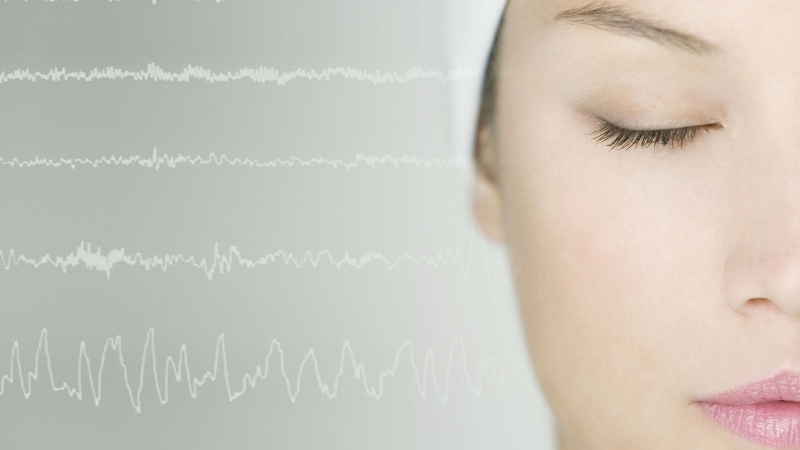
If you’re losing sleep over something that’s bothering you, it’s because your brain’s wired that way. Scientists have discovered that there’s a link between high levels of anxiety and lack of sleep.
Thankfully, there’s a way to rewire your brain to eliminate anxiety — you just need to sleep deeply on it, according to a 2019 study in the journal Nature Human Behavior.
Sleep and anxiety
Over 40 million American adults have been diagnosed with anxiety disorders. Those numbers are skyrocketing among teens and children, as well, and as many as one in three young people between 13 and 18 will experience an anxiety disorder. Researchers say the answer to why this might be happening is simpler than you might think: lack of sleep.
The November 2019 study from the University of California Berkeley had three parts. First, it took sleep data from 30 participants and concluded that those who got more deep sleep at night showed lower levels of anxiety the next day.
The next portion of the study surveyed 280 respondents over four days and found that, regardless of their sleep habits, the quality and length of their sleep the night before was a huge indicator of much anxiety they felt the next day.
Finally, the original 18 study participants were asked to watch a series of disturbing videos after a full night’s sleep and then after a sleepless night. Using brain scans, the researchers found that after a night of insomnia, the brain’s medial prefrontal cortex shuts down and areas like the amygdala light up. The medial prefrontal cortex is responsible for decision-making, logic and reason, and the amygdala is responsible for fear.
In a press release, the study’s senior author, Matthew Walker, vividly described this phenomenon as one’s brain being “too heavy on the emotional accelerator pedal, without enough brake.”
What is deep sleep?
While you might think that a nap is good enough to stave off anxiety, that’s just not the case. This study in particular specified that a full night of deep sleep is necessary to restore the brain’s neural pathways and decrease anxious thoughts. But what qualifies as deep sleep?
There are two kinds of sleep: rapid-eye-movement, or REM, sleep and non-REM sleep. You may have heard that REM sleep is the kind of deep sleep you need to recharge, but that’s not exactly the case. Ideally, your non-REM slow-wave sleep reduces your anxiety the most. This occurs in non-REM stages of your sleep, when your brain waves decelerate and your heart rate is at the lowest point possible.
While your body might be resting during this period, your brain is very active, firing off neurons and neurotransmitters at a rapid rate. This is when you’re rewiring your brain. In these restorative hours, your brain can create thousands of new neural pathways and nurture cell growth to improve your immune system, memory, and, most importantly, lower your anxiety level.
Berkeley’s tips for a good night’s sleep
Getting a solid eight hours filled with anxiety-reducing non-REM sleep can be a challenge, but researchers at Berkeley have tips on how to achieve the perfect night’s sleep.
First, go to bed and wake up each day at the exact same time. Even if you end up going to bed late or you get a terrible night’s sleep, keeping to your sleep schedule will readjust your circadian rhythms. This helps your body get into REM and non-REM rhythms faster when you go to sleep.
Next, keep your screen time to a minimum about an hour before bed. Again, this has to do with your circadian rhythms, and blasting a bright light in your face just as you’re about to sleep isn’t exactly the way to ensure arestful night.
The last tip is to keep your bedroom cool — 65 degrees is recommended, but you can go up to 70 if that’s too chilly. You’ll fall asleep quicker, your quality of sleep will be exponentially greater, and some even say that it aids your metabolism.
For insomniacs, if you’re lying in bed and just can’t get to sleep, don’t get up and hop on your laptop to answer work emails. Instead, get out of bed but do something calming until you start to feel sleepy again. This doesn’t include TV, either, as you should be staying away from electronics when you’re supposed to be sleeping.