'%3e %3cpath d='M15.9571 0.231934L0.147583 9.39139V32.66L15.9571 41.8195L31.7665 32.66V9.39139L15.9571 0.231934ZM15.9571 33.0172L7.68318 28.2206V13.7798L15.9571 9.00869V23.424L24.2309 28.2206L15.9571 33.0172Z' fill='%23170E30'/%3e %3cpath d='M107.275 23.3727C107.275 22.9645 107.275 22.6073 107.275 22.2756C107.275 21.6377 107.021 20.311 106.766 19.7242C104.628 14.6214 96.3791 15.5144 95.5645 21.3316C94.648 28.0417 102.438 30.9248 106.613 26.2302L104.678 24.929C102.464 26.8936 98.9759 26.5619 98.2885 23.3982H106.384H107.275V23.3727ZM98.2885 21.3826C99.0268 17.9382 103.966 17.7596 104.449 21.3826H98.2885ZM58.472 16.5095C53.9914 15.7441 51.1147 19.1629 51.522 23.4492C51.9802 28.0672 57.8865 30.2614 61.0688 26.766V28.1438H63.9964V16.3309C63.9964 16.3309 61.1706 17.9638 61.0433 18.0403C61.0433 18.0403 59.7959 16.7391 58.472 16.5095ZM57.3264 25.822C53.5077 25.3883 53.5332 19.6987 57.0464 19.1119C62.469 18.1934 62.5963 26.4088 57.3264 25.822ZM126.929 25.4648C126.471 29.5981 118.197 29.3429 116.924 25.6944L119.011 24.4698C119.597 26.1537 122.881 27.1487 123.95 25.6944C125.274 23.9085 121.048 23.4747 120.055 23.092C118.91 22.6328 117.586 21.8419 117.408 20.5151C116.72 15.5655 124.765 14.9786 126.623 18.6781L124.689 19.8263C124.103 18.2954 120.157 17.479 120.284 19.6222C120.361 20.8468 123.517 21.204 124.561 21.6633C126.318 22.4287 127.132 23.4747 126.929 25.4648ZM90.5492 18.2954C87.2142 14.3918 81.3334 16.8667 80.8497 21.7908C80.3151 27.4294 86.5523 30.8993 90.5238 26.6129V28.1438H93.2987V12.1211H90.5238V18.2699L90.5492 18.2954ZM87.7998 25.7965C83.1409 26.5874 82.2499 19.7497 86.4759 19.0864C91.2366 18.3465 92.0003 25.0566 87.7998 25.7965ZM75.8599 18.2954L74.918 17.3004C70.0555 14.3408 65.0657 19.0098 66.4404 24.2402C67.4333 28.0162 72.2958 29.9808 75.3253 27.2253C75.5544 27.0212 75.6053 26.6895 75.8599 26.6129V28.1438H78.6348V12.1211H75.8599V18.2699V18.2954ZM73.1104 25.7965C68.3752 26.4854 67.7897 19.7497 71.8121 19.1119C76.7 18.321 77.311 25.2097 73.1104 25.7965ZM112.392 16.6115H109.465V28.1693H112.392V21.102L115.6 19.2394V16.3054C114.709 16.8156 112.876 17.8872 112.392 18.1679V16.6115ZM42.4335 25.3883H49.969V28.1693H39.353V13.7795H42.4335V25.3883Z' fill='%23170E30'/%3e %3c/g%3e %3cdefs%3e %3cclipPath id='clip0_1_15718'%3e %3crect width='127' height='42' fill='white'/%3e %3c/clipPath%3e %3c/defs%3e %3c/svg%3e)

• Engineers developed a mask prototype that can alert the wearer of a COVID-19 diagnosis.
• Sensors placed inside the mask can detect the virus within 90 minutes.
• It can be easily fitted in other garments and can potentially help detect other viruses.
We may one day be wearing face masks that can detect COVID-19 and other pathogens and toxins.
Engineers from Harvard University and the Massachusetts Institute of Technology (MIT) have designed a mask prototype that can alert the wearer of a COVID-19 diagnosis within about 90 minutes.
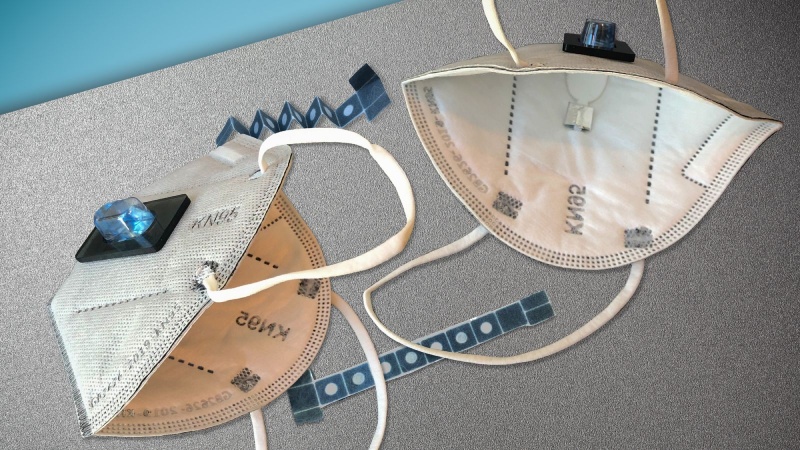
At first glance, there’s nothing obtrusively different about the masks; it’s a standard KN95 mask. However, engineers fitted little, disposable sensors, which they say could be easily fitted to other models and potentially be adapted to detect other viruses.
“We have essentially shrunk an entire diagnostic laboratory down into a small, synthetic biology-based sensor that works with any face mask, and combines the high accuracy of PCR tests with the speed and low cost of antigen tests,” said Peter Nguyen, co-author of the study and a research scientist at the Wyss Institute.
The programmable biosensors could be integrated into other garments, like lab coats, which could then provide “on-the-go detection” of other substances like viruses, bacteria, toxins, and chemical agents, Nguyen said.
The findings, which appear in the journal Nature Biotechnology, could be a breakthrough for healthcare professionals.
“We’ve demonstrated that we can freeze-dry a broad range of synthetic biology sensors to detect viral or bacterial nucleic acids, as well as toxic chemicals, including nerve toxins,” said co-author James Collins, a professor at MIT. “We envision that this platform could enable next-generation wearable biosensors for first responders, health care personnel, and military personnel.”
How the sensors detect COVID-19
The biosensors have been in development for several years, based on freeze-dried cellular machinery that had been used in paper diagnostics for viruses such as Ebola and Zika.
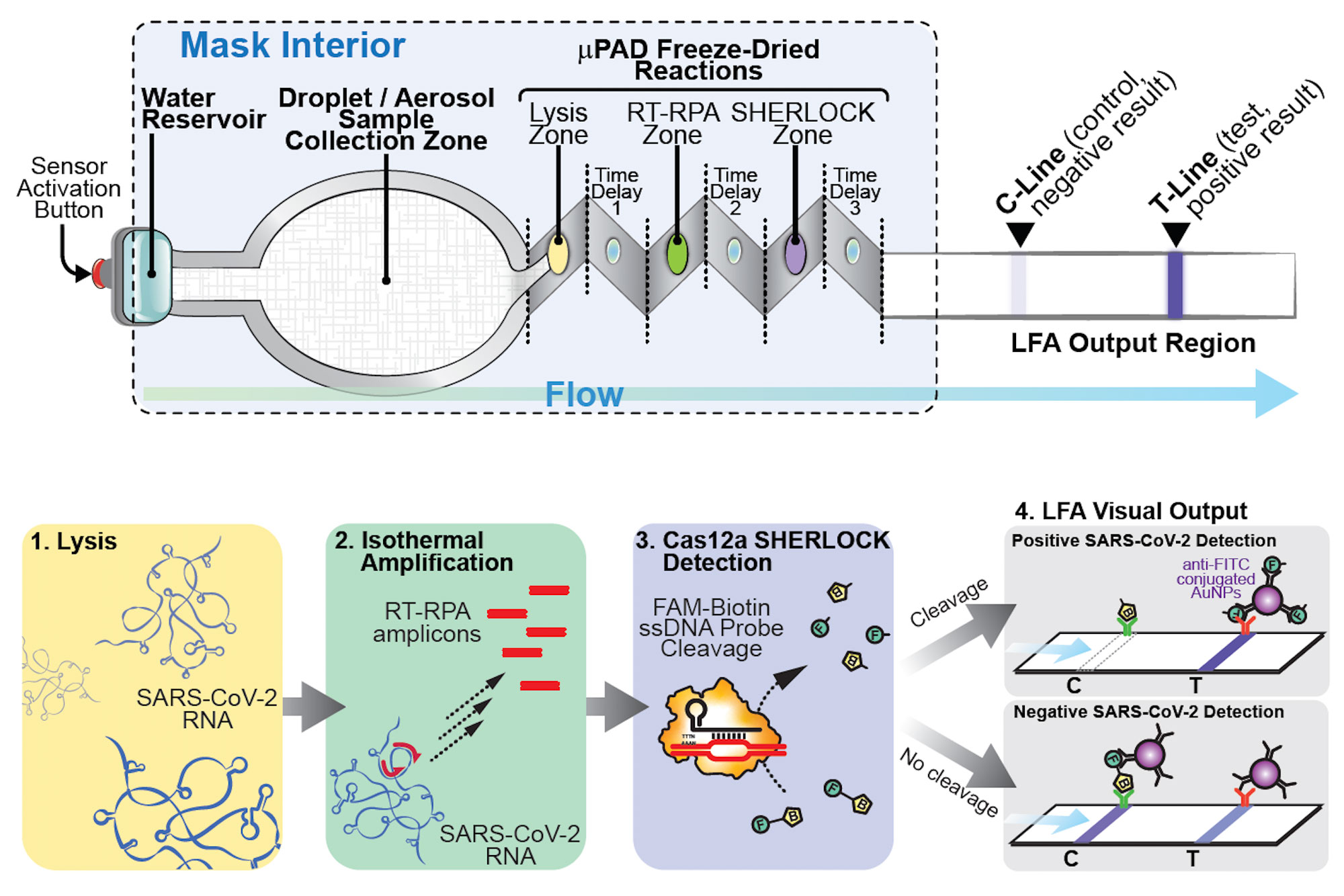
The technology, dubbed wFDCF (wearable freeze-drives cell-free), is a breakthrough in itself. Previous biosensors required living cells to be present, which can be problematic if the little sensor pods are broken.
In an effort to create a useful product to aid the pandemic, researchers integrated wFDCF into face masks during quarantine in 2020.
The biosensors are activated when a button is pressed by the wearer, which hydrates the freeze-dried components and analyzes breath droplets from inside the mask, producing results within 90 minutes.
Sensors on the outside of the garment can also detect exposure from the environment, researchers said.
The mask won’t be available soon
As the Delta variant threatens to prolong the COVID-19 pandemic, these masks would come in handy — but they won’t be around any time soon.
With the threat of other outbreaks and pandemics looming, researchers said they have filed for a patent on the technology and hope to further develop the sensors with a company.
“I think the face mask is probably the most advanced and the closest to a product. We have already had a lot of interest from outside groups that would like to take the prototype efforts we have and advance them to an approved, marketed product,” Collins said.