'%3e %3cpath d='M15.9571 0.231934L0.147583 9.39139V32.66L15.9571 41.8195L31.7665 32.66V9.39139L15.9571 0.231934ZM15.9571 33.0172L7.68318 28.2206V13.7798L15.9571 9.00869V23.424L24.2309 28.2206L15.9571 33.0172Z' fill='%23170E30'/%3e %3cpath d='M107.275 23.3727C107.275 22.9645 107.275 22.6073 107.275 22.2756C107.275 21.6377 107.021 20.311 106.766 19.7242C104.628 14.6214 96.3791 15.5144 95.5645 21.3316C94.648 28.0417 102.438 30.9248 106.613 26.2302L104.678 24.929C102.464 26.8936 98.9759 26.5619 98.2885 23.3982H106.384H107.275V23.3727ZM98.2885 21.3826C99.0268 17.9382 103.966 17.7596 104.449 21.3826H98.2885ZM58.472 16.5095C53.9914 15.7441 51.1147 19.1629 51.522 23.4492C51.9802 28.0672 57.8865 30.2614 61.0688 26.766V28.1438H63.9964V16.3309C63.9964 16.3309 61.1706 17.9638 61.0433 18.0403C61.0433 18.0403 59.7959 16.7391 58.472 16.5095ZM57.3264 25.822C53.5077 25.3883 53.5332 19.6987 57.0464 19.1119C62.469 18.1934 62.5963 26.4088 57.3264 25.822ZM126.929 25.4648C126.471 29.5981 118.197 29.3429 116.924 25.6944L119.011 24.4698C119.597 26.1537 122.881 27.1487 123.95 25.6944C125.274 23.9085 121.048 23.4747 120.055 23.092C118.91 22.6328 117.586 21.8419 117.408 20.5151C116.72 15.5655 124.765 14.9786 126.623 18.6781L124.689 19.8263C124.103 18.2954 120.157 17.479 120.284 19.6222C120.361 20.8468 123.517 21.204 124.561 21.6633C126.318 22.4287 127.132 23.4747 126.929 25.4648ZM90.5492 18.2954C87.2142 14.3918 81.3334 16.8667 80.8497 21.7908C80.3151 27.4294 86.5523 30.8993 90.5238 26.6129V28.1438H93.2987V12.1211H90.5238V18.2699L90.5492 18.2954ZM87.7998 25.7965C83.1409 26.5874 82.2499 19.7497 86.4759 19.0864C91.2366 18.3465 92.0003 25.0566 87.7998 25.7965ZM75.8599 18.2954L74.918 17.3004C70.0555 14.3408 65.0657 19.0098 66.4404 24.2402C67.4333 28.0162 72.2958 29.9808 75.3253 27.2253C75.5544 27.0212 75.6053 26.6895 75.8599 26.6129V28.1438H78.6348V12.1211H75.8599V18.2699V18.2954ZM73.1104 25.7965C68.3752 26.4854 67.7897 19.7497 71.8121 19.1119C76.7 18.321 77.311 25.2097 73.1104 25.7965ZM112.392 16.6115H109.465V28.1693H112.392V21.102L115.6 19.2394V16.3054C114.709 16.8156 112.876 17.8872 112.392 18.1679V16.6115ZM42.4335 25.3883H49.969V28.1693H39.353V13.7795H42.4335V25.3883Z' fill='%23170E30'/%3e %3c/g%3e %3cdefs%3e %3cclipPath id='clip0_1_15718'%3e %3crect width='127' height='42' fill='white'/%3e %3c/clipPath%3e %3c/defs%3e %3c/svg%3e)

Oral health is intrinsically important in our lives. It helps to keep bad bacteria at bay, gives us minty fresh, attractive breath, and provides an esthetically pleasing mouth situation. Plus poor oral health is actually linked to cardiovascular disease, pregnancy and birth complications, pneumonia, and the development of cancer. So, wanting to work as an advocate for oral health is a pretty noble profession, right?
Enter: Dental Hygienists.
What is a dental hygienist?
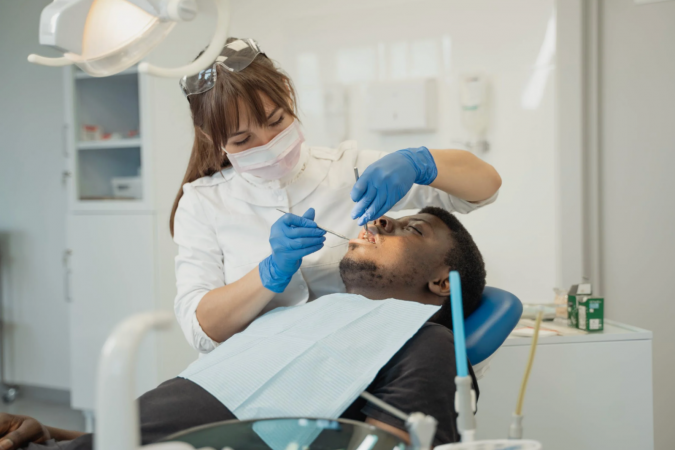
A dental hygienist is someone who works in tandem with a dentist or orthodontist to provide the patient with preventative oral care.
What does a dental hygienist do?
Dental hygienists are often some of the first people you see when led to the dentist’s chair, and the person who you will most intimately know during your time there. They act as an introductory liaison for you, jotting down and analyzing any oral health concerns, taking X-rays, and doing any preparatory procedures.
Hygienists are also heavily involved in the cleaning process and will fit you for molds and other hardware in most cases. Dental Hygienists are the Swiss Army Knife of the dental office.
How do you become a dental hygienist?
The line of work itself can require a lot of patience, but becoming a dental hygienist is a pretty simplified process. Academic programs and continuing education are the only way to obtain a certification for this line of work. Many community colleges and technical schools offer 2-year associate’s programs. Once you have obtained that degree, you are qualified to take the licensure exams required by your region. Your work may require national, state, or regional licensure.
If you are planning on teaching or doing additional work within the field later in life, you may consider earning a baccalaureate or Master’s in dental hygiene. This line of study is often available through a University-based dental program and requires an additional two years of schooling, on average.
If you are applying to a school that specifies your niche work, you will want to highlight any science-driven work you have pursued in the past. High school-level courses like math, chemistry, psychology, and health can actually provide the great groundwork for establishing your career.
What skills do you need to become a dental hygienist?
Dental hygienists require precision. Not all hygienists will be working with patients who take good care of their teeth. Having the ability to detect and identify issues – remember, our mouths are small and the health implications that go along with them are vast – efficiently is important. Being able to handle the patient with care is important as well. Not only are these tools and advanced technology capable of hurting someone, but they’re meant to be handled with care.
Patients should be handled with care communication-wise as well, so amp up those social skills. Many patients will be bleeders at some point in their dental career, so try not to be too hard on them.
What is the average salary for a dental hygienist?
Entry-level dental hygienists make a median salary of $55,265, with the income typically falling between $47,000 and $62,000. The average median salary of all dental hygienists in America was $77,090 per year in 2020 or about $37.06 per hour.
What is the typical career path for a dental hygienist?
Most dental hygienists pursue a two-year degree and go through the ensuing certification process. If they are choosing to approach this career through a university, they may register for a three to four year program, which often indicates a more well-rounded, liberal arts degree.
Some choose to branch off and become mouth, gums, teeth specialists, orthodontists, or dentists and end up taking another five to 10 years of courses.
Highmark is currently looking for PHDHP Dental Hygienists, and Lake Erie College of Osteopathic Medicine, Arrow Dental at Oregon Dental Services, and American Dental Partners are in need of Registered Dental Hygienists.