'%3e %3cpath d='M15.9571 0.231934L0.147583 9.39139V32.66L15.9571 41.8195L31.7665 32.66V9.39139L15.9571 0.231934ZM15.9571 33.0172L7.68318 28.2206V13.7798L15.9571 9.00869V23.424L24.2309 28.2206L15.9571 33.0172Z' fill='%23170E30'/%3e %3cpath d='M107.275 23.3727C107.275 22.9645 107.275 22.6073 107.275 22.2756C107.275 21.6377 107.021 20.311 106.766 19.7242C104.628 14.6214 96.3791 15.5144 95.5645 21.3316C94.648 28.0417 102.438 30.9248 106.613 26.2302L104.678 24.929C102.464 26.8936 98.9759 26.5619 98.2885 23.3982H106.384H107.275V23.3727ZM98.2885 21.3826C99.0268 17.9382 103.966 17.7596 104.449 21.3826H98.2885ZM58.472 16.5095C53.9914 15.7441 51.1147 19.1629 51.522 23.4492C51.9802 28.0672 57.8865 30.2614 61.0688 26.766V28.1438H63.9964V16.3309C63.9964 16.3309 61.1706 17.9638 61.0433 18.0403C61.0433 18.0403 59.7959 16.7391 58.472 16.5095ZM57.3264 25.822C53.5077 25.3883 53.5332 19.6987 57.0464 19.1119C62.469 18.1934 62.5963 26.4088 57.3264 25.822ZM126.929 25.4648C126.471 29.5981 118.197 29.3429 116.924 25.6944L119.011 24.4698C119.597 26.1537 122.881 27.1487 123.95 25.6944C125.274 23.9085 121.048 23.4747 120.055 23.092C118.91 22.6328 117.586 21.8419 117.408 20.5151C116.72 15.5655 124.765 14.9786 126.623 18.6781L124.689 19.8263C124.103 18.2954 120.157 17.479 120.284 19.6222C120.361 20.8468 123.517 21.204 124.561 21.6633C126.318 22.4287 127.132 23.4747 126.929 25.4648ZM90.5492 18.2954C87.2142 14.3918 81.3334 16.8667 80.8497 21.7908C80.3151 27.4294 86.5523 30.8993 90.5238 26.6129V28.1438H93.2987V12.1211H90.5238V18.2699L90.5492 18.2954ZM87.7998 25.7965C83.1409 26.5874 82.2499 19.7497 86.4759 19.0864C91.2366 18.3465 92.0003 25.0566 87.7998 25.7965ZM75.8599 18.2954L74.918 17.3004C70.0555 14.3408 65.0657 19.0098 66.4404 24.2402C67.4333 28.0162 72.2958 29.9808 75.3253 27.2253C75.5544 27.0212 75.6053 26.6895 75.8599 26.6129V28.1438H78.6348V12.1211H75.8599V18.2699V18.2954ZM73.1104 25.7965C68.3752 26.4854 67.7897 19.7497 71.8121 19.1119C76.7 18.321 77.311 25.2097 73.1104 25.7965ZM112.392 16.6115H109.465V28.1693H112.392V21.102L115.6 19.2394V16.3054C114.709 16.8156 112.876 17.8872 112.392 18.1679V16.6115ZM42.4335 25.3883H49.969V28.1693H39.353V13.7795H42.4335V25.3883Z' fill='%23170E30'/%3e %3c/g%3e %3cdefs%3e %3cclipPath id='clip0_1_15718'%3e %3crect width='127' height='42' fill='white'/%3e %3c/clipPath%3e %3c/defs%3e %3c/svg%3e)

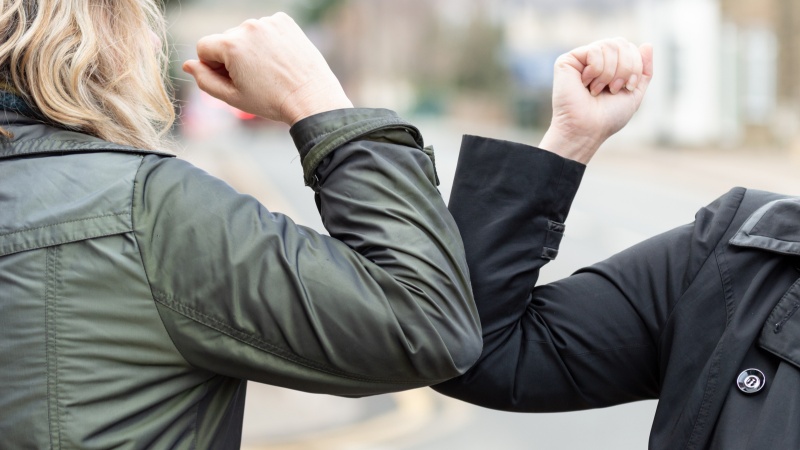
Is the potentially germy handshake a thing of the past? Seems to be so. And no one knows what will replace it in these vaccinated times, but the contenders clearly include elbow bump, fist bump, bow, wave, smile, and nod.
“Just before lockdowns happened, fist and elbow bumps were semi-humorously adopted,” says William W. Li, MD, a physician, and author of Eat to Beat Disease. “Then, during the lockdown, no one had physical contact and everyone became used to it.”
Now, as the world reopens, it’s time for some new rules when meeting face-to-face even though it’s nearly impossible to imagine a business deal taking place without a firm handshake, says Maryanne Parker, an etiquette expert in San Diego.
“The handshake has been practiced as far back as the Fifth Century in Greece and signifies peace and friendliness,” Parker says. “But you can find a post-Covid-19 replacement. My suggestion: Place your right hand on top of your heart, nod gently, and look the person in front of you in the eye.”
What’s safe and what’s not?
As new as this is for all of us, it’s imperative to keep your vaccination status in mind when interacting with a colleague, Dr. Li says. For example, if you’re fully vaccinated, your chances of becoming infected are low. And, if your colleague is also fully vaccinated, both of you are safe to greet each other with a handshake or elbow bump—without a mask and at close range.
However, if you’re fully vaccinated but are unsure of the vaccination status of your business colleague, this interaction isn’t as clear-cut.

“You’re probably safe to shake hands with your colleague if they’re not vaccinated, but there is a risk you could transmit disease to this person,” Dr. Li says, adding that if you’re not fully vaccinated, it’s safest for you to smile and give a polite nod without any physical contact. You should also continue to wear a mask during business meetings and maintain social distance from others. “I’d recommend acknowledging your colleague with a polite nod of your head. Let this person know that you’re avoiding any physical contact for their protection.”
As we navigate our post-pandemic interactions, it helps to focus on the fact that a greeting is meant to convey warm feelings as an opening to your interaction, says Gail Saltz, MD, associate professor of psychiatry at the New York Presbyterian Hospital Weill-Cornell School of Medicine.
“In the working world, there are many people you may meet in a day with whom you wish to convey this friendly and respectful hello and yet you don’t wish to physically touch this person,” she says.
“Some cultures use a tiny bow forward or put their hands together in front of their body,” Dr. Saltz says. “The point is to offer a respectful extra gesture that connotes ‘I am offering you my respect and friendliness’ as we begin our interaction.”
Or, consider the fact that a smile is better than a wave or fist bump any day of the week.
“A smile conveys warmth while lighting up the whole face,” says Karla Karpowicz, a body-based psychotherapist in Newburgh, New York, who uses movement as a tool within the counseling process. “When you smile it lets the other person know that you see them and value their presence and will make any colleague feel welcomed in the moment.”
Less common ways to greet someone
One alternative is to come up with your own special gesture, especially if you’re conducting international business in parts of the world with low vaccination rates and in places that are struggling to control their infections.
“Doing a little research can inform you of what the situation is in the home country of international colleagues,” Dr. Li says. “Being considerate of the situation of others will go far and get you over the awkward hump of how to greet people in 2021 and beyond.”
Ultimately, it may just be time to set aside the custom of shaking hands entirely. That will help keep even the mildest infectious diseases under control and make workplace interactions far less awkward.
“People may decide they don’t need to shake hands and, instead, will want to use their words,” Dr. Saltz says. “This can be something like ‘Hello, I am happy to greet you and look forward to our meeting.’ A few extra words can convey as much or more than a handshake ever could.”