'%3e %3cpath d='M15.9571 0.231934L0.147583 9.39139V32.66L15.9571 41.8195L31.7665 32.66V9.39139L15.9571 0.231934ZM15.9571 33.0172L7.68318 28.2206V13.7798L15.9571 9.00869V23.424L24.2309 28.2206L15.9571 33.0172Z' fill='%23170E30'/%3e %3cpath d='M107.275 23.3727C107.275 22.9645 107.275 22.6073 107.275 22.2756C107.275 21.6377 107.021 20.311 106.766 19.7242C104.628 14.6214 96.3791 15.5144 95.5645 21.3316C94.648 28.0417 102.438 30.9248 106.613 26.2302L104.678 24.929C102.464 26.8936 98.9759 26.5619 98.2885 23.3982H106.384H107.275V23.3727ZM98.2885 21.3826C99.0268 17.9382 103.966 17.7596 104.449 21.3826H98.2885ZM58.472 16.5095C53.9914 15.7441 51.1147 19.1629 51.522 23.4492C51.9802 28.0672 57.8865 30.2614 61.0688 26.766V28.1438H63.9964V16.3309C63.9964 16.3309 61.1706 17.9638 61.0433 18.0403C61.0433 18.0403 59.7959 16.7391 58.472 16.5095ZM57.3264 25.822C53.5077 25.3883 53.5332 19.6987 57.0464 19.1119C62.469 18.1934 62.5963 26.4088 57.3264 25.822ZM126.929 25.4648C126.471 29.5981 118.197 29.3429 116.924 25.6944L119.011 24.4698C119.597 26.1537 122.881 27.1487 123.95 25.6944C125.274 23.9085 121.048 23.4747 120.055 23.092C118.91 22.6328 117.586 21.8419 117.408 20.5151C116.72 15.5655 124.765 14.9786 126.623 18.6781L124.689 19.8263C124.103 18.2954 120.157 17.479 120.284 19.6222C120.361 20.8468 123.517 21.204 124.561 21.6633C126.318 22.4287 127.132 23.4747 126.929 25.4648ZM90.5492 18.2954C87.2142 14.3918 81.3334 16.8667 80.8497 21.7908C80.3151 27.4294 86.5523 30.8993 90.5238 26.6129V28.1438H93.2987V12.1211H90.5238V18.2699L90.5492 18.2954ZM87.7998 25.7965C83.1409 26.5874 82.2499 19.7497 86.4759 19.0864C91.2366 18.3465 92.0003 25.0566 87.7998 25.7965ZM75.8599 18.2954L74.918 17.3004C70.0555 14.3408 65.0657 19.0098 66.4404 24.2402C67.4333 28.0162 72.2958 29.9808 75.3253 27.2253C75.5544 27.0212 75.6053 26.6895 75.8599 26.6129V28.1438H78.6348V12.1211H75.8599V18.2699V18.2954ZM73.1104 25.7965C68.3752 26.4854 67.7897 19.7497 71.8121 19.1119C76.7 18.321 77.311 25.2097 73.1104 25.7965ZM112.392 16.6115H109.465V28.1693H112.392V21.102L115.6 19.2394V16.3054C114.709 16.8156 112.876 17.8872 112.392 18.1679V16.6115ZM42.4335 25.3883H49.969V28.1693H39.353V13.7795H42.4335V25.3883Z' fill='%23170E30'/%3e %3c/g%3e %3cdefs%3e %3cclipPath id='clip0_1_15718'%3e %3crect width='127' height='42' fill='white'/%3e %3c/clipPath%3e %3c/defs%3e %3c/svg%3e)

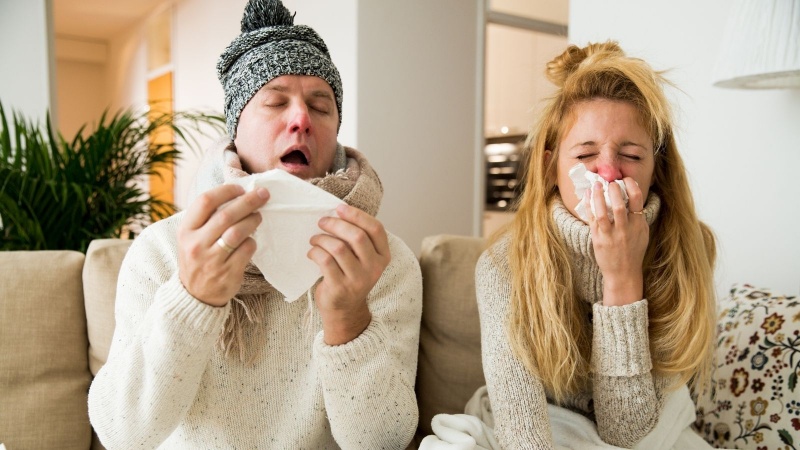
COVID has a way of monopolizing the news cycle. Because of this, it’s easy to forget that the health threats of old are still around and kicking.
Medical experts are encouraging people to take necessary precautions to avoid contracting the flu this year while the novel coronavirus is circulating around the country. Brace yourselves for a twindemic.
The flu is back… with a vengeance
Last year the pandemic indirectly reduced our overall risk for influenza infection because of the increased emphasis on public health guidance; we wore masks, stayed socially distant, and so on.
“As the flu — like COVID-19 — is a respiratory disease, experts suspect that the prevention measures that people took to avoid SARS-CoV-2 infections also proved effective in preventing the flu,” Medical News Today reports.
“Wearing masks, practicing physical distancing, washing the hands regularly, disinfecting surfaces, reducing travel, and closing schools all served to limit the flu’s ability to infect people.”
This year may be different.
For a start, many Americans are slacking on countermeasures because they’re vaccinated (or not vaccinated for personal, political or religious reasons).
We are also seeing reduced immunity.
“We saw an extremely low level of influenza last year, which is fantastic. However, that means that there are fewer people in the population that are relatively protected due to natural infection, and the virus may have an easier time spreading among the unvaccinated. On a population level, both vaccinated people and people who have immunity after having recovered from previous infections help to limit the spread of the virus,” said
Dr. Patrick E. H. Jackson, infectious disease and international health expert of the University of Virginia.
Experts warn of a Twindemic
Twindemic is a term coined last year that referred to the potential of a severe flu season occurring alongside an increase in cases of COVID-19 during the fall and winter months. Research that indicated those who were sick with COVID and the flu simultaneously experienced more serious symptoms as a result.
The Centers for Disease Control and Prevention (CDC) Trusted Source report that in the United States, there were fewer confirmed cases of hospitalization due to flu than in any other year since the collection of such data.
“Co-infection would also complicate treatment for hospitalized patients,” Jackson continued.
Steroids are instrumental in COVID-19 relief, while being harmful to the recovery of flu patients. Also, hospitals are overwhelmed as it is without an influx of flu patients.
How to stay protected
Influenza viruses spread in the same way the coronavirus that causes COVID-19 (SARS-CoV-2) spreads: Infected droplets disperse when a carrier coughs, sneezes, breathes, or talks. Unlike SARS-CoV-2, these droplets cannot remain suspended in the air.
Experts recommend getting vaccinated for both illnesses to avoid developing severe manifestations of either. The Centers for Disease Control and Prevention say the different vaccines will not induce any adverse health effects.
“Some practices — like washing your hands frequently and avoiding exposing other people when you’re feeling ill — just make good sense and should continue indefinitely. I also think that wearing a mask in public when rates of influenza or COVID-19 are high continues to be a good idea — particularly for medically vulnerable people,” Dr. Jackson said.