'%3e %3cpath d='M15.9571 0.231934L0.147583 9.39139V32.66L15.9571 41.8195L31.7665 32.66V9.39139L15.9571 0.231934ZM15.9571 33.0172L7.68318 28.2206V13.7798L15.9571 9.00869V23.424L24.2309 28.2206L15.9571 33.0172Z' fill='%23170E30'/%3e %3cpath d='M107.275 23.3727C107.275 22.9645 107.275 22.6073 107.275 22.2756C107.275 21.6377 107.021 20.311 106.766 19.7242C104.628 14.6214 96.3791 15.5144 95.5645 21.3316C94.648 28.0417 102.438 30.9248 106.613 26.2302L104.678 24.929C102.464 26.8936 98.9759 26.5619 98.2885 23.3982H106.384H107.275V23.3727ZM98.2885 21.3826C99.0268 17.9382 103.966 17.7596 104.449 21.3826H98.2885ZM58.472 16.5095C53.9914 15.7441 51.1147 19.1629 51.522 23.4492C51.9802 28.0672 57.8865 30.2614 61.0688 26.766V28.1438H63.9964V16.3309C63.9964 16.3309 61.1706 17.9638 61.0433 18.0403C61.0433 18.0403 59.7959 16.7391 58.472 16.5095ZM57.3264 25.822C53.5077 25.3883 53.5332 19.6987 57.0464 19.1119C62.469 18.1934 62.5963 26.4088 57.3264 25.822ZM126.929 25.4648C126.471 29.5981 118.197 29.3429 116.924 25.6944L119.011 24.4698C119.597 26.1537 122.881 27.1487 123.95 25.6944C125.274 23.9085 121.048 23.4747 120.055 23.092C118.91 22.6328 117.586 21.8419 117.408 20.5151C116.72 15.5655 124.765 14.9786 126.623 18.6781L124.689 19.8263C124.103 18.2954 120.157 17.479 120.284 19.6222C120.361 20.8468 123.517 21.204 124.561 21.6633C126.318 22.4287 127.132 23.4747 126.929 25.4648ZM90.5492 18.2954C87.2142 14.3918 81.3334 16.8667 80.8497 21.7908C80.3151 27.4294 86.5523 30.8993 90.5238 26.6129V28.1438H93.2987V12.1211H90.5238V18.2699L90.5492 18.2954ZM87.7998 25.7965C83.1409 26.5874 82.2499 19.7497 86.4759 19.0864C91.2366 18.3465 92.0003 25.0566 87.7998 25.7965ZM75.8599 18.2954L74.918 17.3004C70.0555 14.3408 65.0657 19.0098 66.4404 24.2402C67.4333 28.0162 72.2958 29.9808 75.3253 27.2253C75.5544 27.0212 75.6053 26.6895 75.8599 26.6129V28.1438H78.6348V12.1211H75.8599V18.2699V18.2954ZM73.1104 25.7965C68.3752 26.4854 67.7897 19.7497 71.8121 19.1119C76.7 18.321 77.311 25.2097 73.1104 25.7965ZM112.392 16.6115H109.465V28.1693H112.392V21.102L115.6 19.2394V16.3054C114.709 16.8156 112.876 17.8872 112.392 18.1679V16.6115ZM42.4335 25.3883H49.969V28.1693H39.353V13.7795H42.4335V25.3883Z' fill='%23170E30'/%3e %3c/g%3e %3cdefs%3e %3cclipPath id='clip0_1_15718'%3e %3crect width='127' height='42' fill='white'/%3e %3c/clipPath%3e %3c/defs%3e %3c/svg%3e)

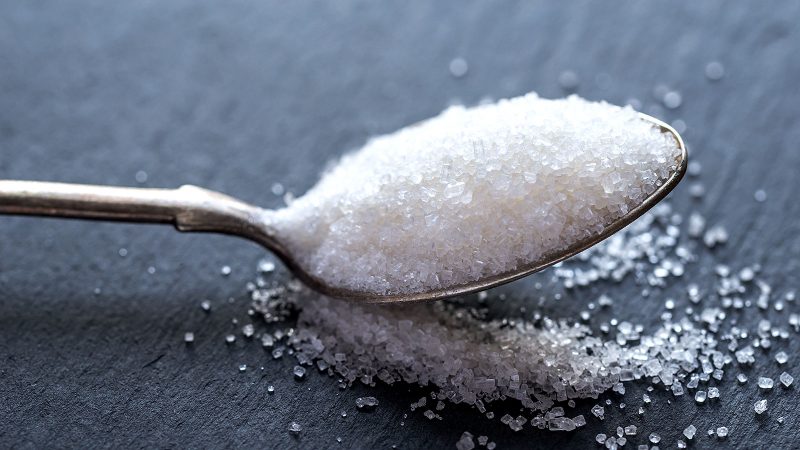
Recent dietary guidelines have suggested that Americans are gradually consuming more and more sugar every year. It’s probably not a coincidence that obesity and disease incidence has been rising in the US in recent years as well.
According to a new study published in the Journal of Hepatology, even moderate amounts of added fructose and sucrose can double the body’s production of fat in the liver.
Over time, fatty liver disease—clinically referred to as hepatic steatosis, increases one’s risk for inflammation, diabetes, organ scarring, and liver cancer. Although excessive sugar intake contributes to all of these outcomes, not all sugar is created equal in this regard.
The team of researchers from the University of Zurich and the University Hospital Zurich derived their results from a sample comprised of 94 healthy young men.
The participants in the experiment group were administered a drink sweetened with different types of sugar solutions ( fructose, glucose, or sucrose) every day for seven weeks, while those in the control group did not.
“This study investigated the metabolic effects of daily sugar-sweetened beverage consumption for several weeks in healthy lean men. It revealed that beverages sweetened with the sugars fructose and sucrose (glucose and fructose combined), but not glucose, increase the ability of the liver to produce lipids. This change may pave the way for further unfavorable effects on metabolic health,” the authors wrote in the new paper.
“We hypothesize that this switch of the liver metabolism by fructose intake towards a higher lipogenic activity may pave the way to further changes affecting metabolic health.”
Sucrose proved to yield the most dramatic adverse impact. Not only does sucrose boost liver fat production the most reliably, but it’s also the most common kind of sugar consumed in the US.
Sucrose is found most commonly in fast food, puddings, milkshakes, cakes, fruit juice drinks, deep-fried meats with sweet sauce, cookies, pancakes, chocolate, and commercial cereals.
Healthy men in the fructose group evidenced liver fat production twice as high as those belonging to the glucose group.
Eighty grams of sugar a day, or roughly 0.8 liters, appeared to initiate the over production of fat in the liver. The men in the glucose and fructose group continued to overproduce fat in their liver after they were taken of the experiment regimen.
Normal fat production can be achieved with dietary changes and regular excercise.
The World Health Organization recommends otherwise healthy adults shoot for a daily sugar value between 25 and 50 grams.
“Look for added sugars in the ingredients list. The higher up added sugars are on the list, the more added sugar is in the product. Added sugars go by a lot of different names like brown sugar, corn sweetener, corn syrup, dextrose, fructose, glucose, high-fructose corn syrup, honey, invert sugar, lactose, malt syrup, maltose, molasses, raw sugar, sucrose, trehalose, and turbinado sugar,” the Department of Health and Human Services and the U.S. Department of Agriculture reports.
“Eating and drinking too many foods and beverages with added sugars makes it difficult to achieve a healthy eating pattern without taking in too many calories.”